
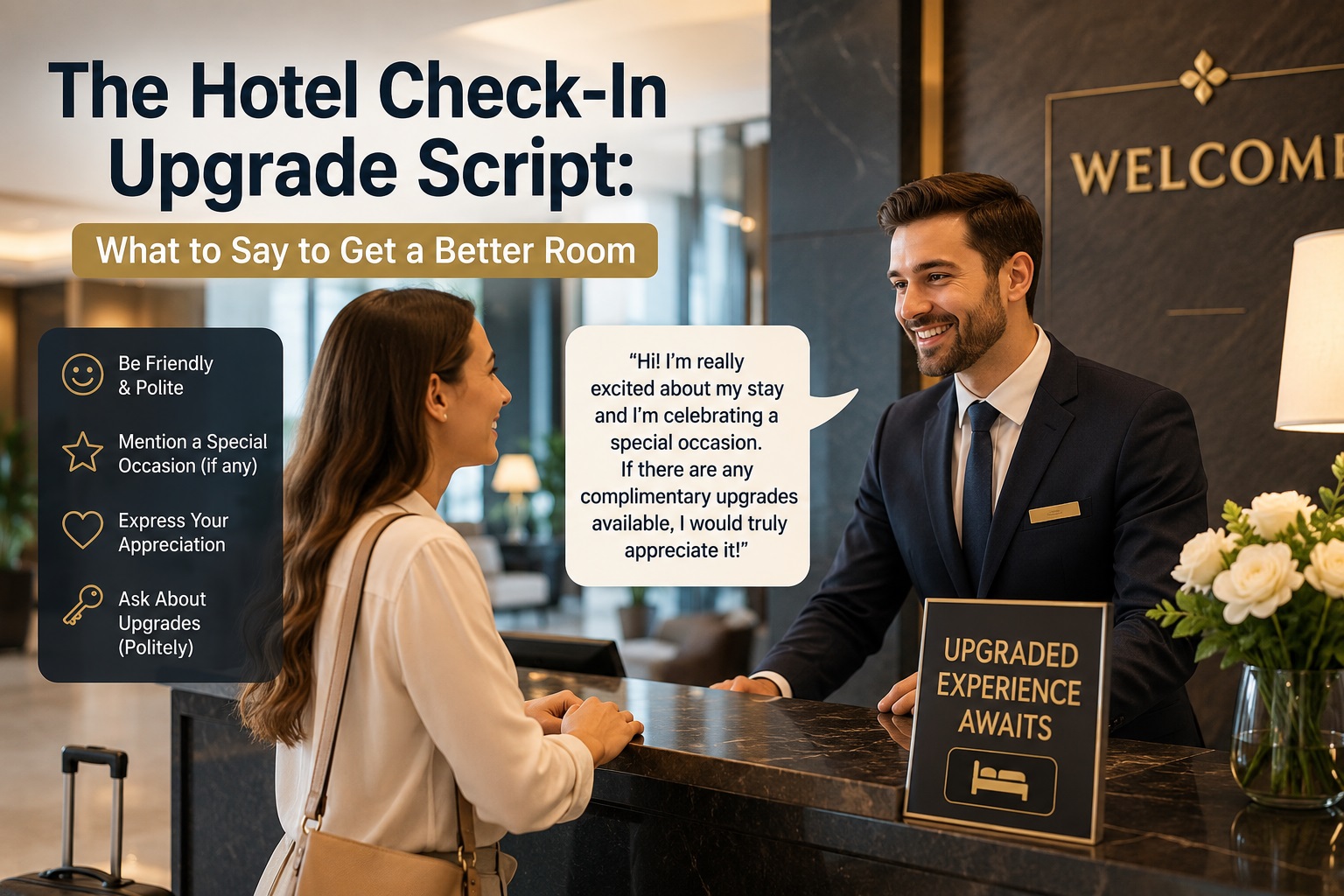
The Hotel Check-In Upgrade Script: What to Say to Get a Better Room
Most people approach hotel check-in the same way they approach a vending machine: insert card, receive room, move on. The interaction is transactional, brief, and leaves significant value on the table.
The front desk agent who checks you in has, in most cases, some degree of discretion over which room you receive. Not unlimited discretion — the property management system, the hotel’s revenue targets, and the occupancy picture constrain what’s possible. But within those constraints, there’s almost always a range of outcomes, and the interaction you have at check-in influences where in that range you land.
This is not about manipulation or charm offensives or elaborate scripts that require you to become a different person at a hotel counter. It’s about understanding what the person across the desk is trying to accomplish, giving them a reason to help you, and asking for what you want in a way that makes it easy for them to say yes.
What’s Happening on the Other Side of the Desk
Before the script, the context — because the script works better when you understand why it works.
A front desk agent at a moderately busy hotel is managing a check-in queue, answering calls, handling requests from guests already in the building, and simultaneously making room assignment decisions for the day’s arrivals. They’ve looked at the availability picture for the night — which room types are full, which have availability, which guests are scheduled for complimentary upgrades through the loyalty program — before you walked up.
They already know, in most cases, whether an upgrade is possible for you before you open your mouth. What your interaction determines is whether they offer it.
Agents have a term for this that varies by property, but the concept is consistent: guests they want to help versus guests they have to help. A guest who is patient, engaged, pleasant without being performatively so, and who makes a clear and unpressured request goes in the first category. A guest who is distracted, perfunctory, or who opens with a complaint goes in the second. The agent’s discretion lands differently depending on which category you’re in.
This is not about being fake. It’s about bringing the same social intelligence to a hotel counter that you’d bring to any interaction where you’re asking someone for something.
The Preparation That Happens Before You Arrive
The check-in conversation is not where an upgrade is won or lost. It’s where it’s confirmed. The groundwork is laid beforehand.
Book directly with the hotel. Guests who booked through Booking.com, Expedia, or any other third-party platform are flagged in the property management system as third-party bookings. The hotel paid a commission on that booking — typically 15–25% of the room rate. A guest who booked directly represents more revenue to the hotel, and the system and the agents know it. Direct bookings get preferred treatment at most properties, and upgrade consideration is part of that.
Have and mention your loyalty status. If you have status with the hotel’s loyalty program, it should already be attached to your reservation. If it isn’t — if you joined after booking — call the hotel or email before arrival to add your member number. Status members are pre-flagged for upgrade consideration in the system; it doesn’t happen automatically, but it puts you in a different queue than non-members.
Email or call the hotel before you arrive. A brief email sent two to three days before check-in — mentioning that you’re looking forward to your stay, noting anything special about the occasion if relevant, and asking whether any room upgrades might be available — does two things. It gets your name in front of the front desk team before arrival, and it gives the hotel an opportunity to look at your reservation and note the request. This is not pushy; it’s the kind of outreach hotels appreciate because it signals an engaged guest.
The email doesn’t need to be elaborate:
“Hello, I’m arriving on [date] and very much looking forward to the stay. I’m a [loyalty program] member (number: XXXX) and wondering if there’s any chance of a room upgrade if availability allows. No worries at all if not — just wanted to ask in advance. Thank you.”
That’s it. Short, specific, gracious about a no. A surprising number of people receive upgrades this way before they’ve even arrived.
How to Find a Good Hotel Without Paying Full Price
The Check-In Conversation: The Actual Script
You’ve arrived. You’re at the desk. The agent greets you and asks for your name or reservation.
Step one: make the interaction human before it’s transactional.
This doesn’t mean launching into a long conversation that holds up the queue behind you. It means a brief, genuine exchange that signals you’re paying attention. Ask the agent how their day is going. If there’s something specific to respond to — they’re wearing a name badge, there’s something on the desk, you’ve just come from somewhere interesting — a one-sentence comment. The goal is ten to fifteen seconds of non-transactional exchange before you get to the room.
This sounds like a small thing. It shifts the interaction in ways that are hard to quantify and entirely real.
Step two: be specific and positive about your stay.
As they’re looking up your reservation: “I’m really looking forward to this one — we haven’t been to [city] in a while” or “It’s our anniversary trip, so we’re excited.” This does two things: it signals that this stay matters to you (which makes an upgrade gesture have more emotional value to the hotel), and if there’s an occasion noted in the reservation or mentioned in a pre-arrival email, it reinforces it.
Keep it brief and genuine. One sentence. Don’t belabor it.
Step three: the ask.
After they’ve confirmed the reservation but before the keys are produced:
“Is there any chance of a room upgrade tonight if anything’s available?”
That’s the ask. That’s the whole script. Delivered once, conversationally, without pressure. If the agent hesitates or looks at the screen, you can add:
“Even a higher floor or a better view would be wonderful if there’s something available.”
This lowered bar — you’re not asking for a suite, you’re asking for a nicer version of what you booked — makes it easier for the agent to say yes to something. It’s easier to give a guest a room on the 12th floor instead of the 3rd than to move them to a completely different room category.
Step four: accept the answer gracefully.
If the answer is yes: thank them specifically and genuinely, not effusively. “That’s great, thank you so much — I really appreciate it.” Agents who make upgrade decisions remember the guests who were gracious about receiving them; this matters if you have other interactions during the stay.
If the answer is no: “No worries at all, I appreciate you checking.” Full stop. No further request, no visible disappointment, no attempt to renegotiate. A guest who accepts a no without drama leaves the door open for the agent to reconsider if something changes during the day — and occasionally they call back to say something opened up.
Never ask twice in the same interaction. The first no is final.
Timing: When to Check In for Maximum Upgrade Potential
The timing of your check-in affects the outcome more than most people realize.
Mid-to-late afternoon is better than early afternoon. By 3–4pm, the hotel has a complete picture of that day’s arrivals, departures, and no-shows. The front desk knows exactly which rooms are available, which arrivals aren’t coming, and which room categories have surplus. The upgrade decision is easiest to make when this information is complete.
Early check-ins — before noon — happen before many room types have freed up from the previous night’s departures. The agent may genuinely not know what’s available to offer you.
Weekdays at business hotels, weekends at leisure hotels. Business hotels have surplus room inventory on Friday and Saturday nights when corporate travelers leave and leisure travelers don’t always fill the gap. Leisure hotels have surplus on Sunday through Tuesday when the weekend visitors have gone. Check-in on a night when the hotel is at 70% occupancy and the upgrade conversation is easier than on a Friday night in July when the hotel is fully booked.
After a long travel day, which you can mention briefly. “I’ve been traveling since 5am — I’m really looking forward to getting settled in.” This is not manipulation; it’s human context that makes an upgrade feel like a specifically kind gesture rather than a standard transaction. Agents respond to guests they feel they’ve genuinely helped.
The Hotel Upgrade System Explained: How Hotels Decide Who Gets a Better Room
What to Do When It Doesn’t Work at Check-In
You’ve made the ask, the answer was no, and you’re in your room. The conversation isn’t necessarily over for the duration of your stay.
Call the front desk the following morning. Occupancy changes overnight. A room that was full yesterday may have a departure today. A brief call — “Good morning, I’m in room 412 — I mentioned at check-in that I’d love an upgrade if anything became available. Any chance something has opened up?” — occasionally produces results on day two that weren’t available on day one.
Talk to the duty manager rather than the front desk agent if you’ve had a genuinely legitimate reason to be dissatisfied — a noisy room, a maintenance issue, something that genuinely affected your stay. A duty manager has more discretion than a front desk agent and is specifically empowered to make things right. This is different from manufacturing a complaint as a tactic; it’s raising a real issue and allowing the hotel to respond appropriately.
At checkout, note what worked well and what didn’t. Hotels take checkout feedback seriously, and a guest who mentions at checkout that a specific room issue made the stay less comfortable creates a record that affects future stays. Mentioning it to the agent directly — calmly, specifically, not accusatorially — is appropriate and often produces a gesture: points added to your account, a discount on a future stay, or a direct commitment that your next stay will be handled differently.
The Properties Where This Works Best
The upgrade conversation is not equally productive at every type of property.
Independent and boutique hotels have the most front desk discretion. The person checking you in may be the owner, or may report directly to someone who is. Upgrade decisions at these properties are genuinely personal and the conversation has real weight.
Mid-tier chain hotels — Marriott Courtyard, Hilton Garden Inn, Hyatt Place — operate with more system-driven constraints but still have agent discretion within a defined band. These are the properties where the ask most reliably produces either a yes or a clear, honest no.
Luxury properties have the most sophisticated upgrade management systems and the most inventory to work with, but also the most competing demands on that inventory — high-status loyalty members, VIPs, long-stay guests. The ask is still worth making, but the system factors matter more relative to the conversation.
Large airport and convention hotels during busy periods are the least responsive to the check-in conversation. When a hotel is processing three hundred check-ins on the day of a large conference, the interaction is genuinely transactional and the discretion is minimal. Adjust expectations accordingly.
The Mindset Underneath the Script
The most important thing about the check-in upgrade conversation is that it works because it’s genuine, not because it follows a script.
Agents who do this job for any length of time develop an accurate sense of who is performing pleasantness versus who is simply pleasant. The traveler who asks for an upgrade with real ease — who clearly doesn’t need it to have a good stay, who asks once and drops it without pressure — is more likely to receive it than the traveler who has clearly rehearsed a set of lines and is nervously executing them.
The paradox of upgrade conversations is that the people who care least about the outcome are the ones who most reliably get a good one. Not because the universe rewards non-attachment, but because ease reads as confidence, confidence reads as a person worth making a gesture for, and a person worth making a gesture for is who the agent’s discretion goes to.
Ask genuinely, accept any answer graciously, and most of the time it comes out fine.
Staying somewhere specific soon and want to know how likely an upgrade ask is to land given the property type and your loyalty status? Drop the details in the comments.