

How to Eat Well While Traveling Without Spending a Fortune
There’s a version of budget travel where eating well means accepting that food is just fuel — grab whatever’s cheapest, don’t think too hard about it, move on. I did that for about three weeks on my first long trip and came home having saved money and eaten almost nothing memorable. A few months later I went back to the same region with a different approach and came home ten pounds heavier and with a list of meals I still think about.
The assumption that eating cheaply means eating badly is one of the most persistent myths in travel. In most of the world, the cheapest food is the food that locals actually eat — and locals, by definition, have been eating this food their entire lives and have strong opinions about where it’s done well. The expensive food is the tourist food: the translated menu, the sanitized version of a dish, the restaurant that exists because someone figured out that people arriving from expensive countries will pay three times the local rate if you put them somewhere scenic.
Understanding that dynamic — and acting on it — is the foundation of eating well on a budget while traveling. Everything else is detail.
Learn One Phrase Before You Arrive
Not a menu item. Not “thank you.” The single most useful phrase in any language for a food-focused traveler is some version of: where do locals eat?
Ask it at your guesthouse. Ask the person at the front desk of your hotel. Ask the person who drives you from the airport. Ask the barista at a coffee shop you stop into on your first morning. Ask anyone whose job is not directly selling you something.
The answers are almost always specific and almost always good. Not “there are some nice restaurants near the square” — that’s what they tell tourists. The answer to where do you actually go for lunch is a street name, a market stall number, a grandmother’s place on a side road that has no English sign. That’s the information worth having.
This works everywhere. In Bangkok, in Naples, in Marrakech, in Mexico City. People who live somewhere are proud of their food culture and genuinely pleased when a visitor wants to engage with it honestly rather than through its tourist-facing version. The question opens doors that no guidebook can.
Markets Are the Answer to Almost Every Food Budget Problem

Every city in the world has a market. Most tourists walk through them to take photographs and then go eat at a restaurant. The people who eat well and cheaply walk through them with a bag and a plan.
Covered food markets — the kind with permanent stalls selling prepared food alongside raw ingredients — are usually the best lunch option in any city. The vendors are competing directly with each other for the same customer base, which keeps quality up and prices down. A market stall serving the same dish as the restaurant three streets away will almost always do it better and cheaper, because the restaurant is paying for a dining room, waitstaff, and the assumption that tourists will pay a premium for sitting down.
Barcelona’s Boqueria is the famous example, and it’s been so thoroughly colonized by tourists that it’s mostly useless for actual eating now. But the Mercat de l’Abaceria in Gràcia and the Mercat de Sarrià serve the same function for actual Barcelona residents — prepared food, fresh ingredients, prices aimed at people who shop here every week, not people who are passing through once.
Every city has this equivalent. The trick is finding the market that serves the neighborhood rather than the one that serves the tourist circuit.
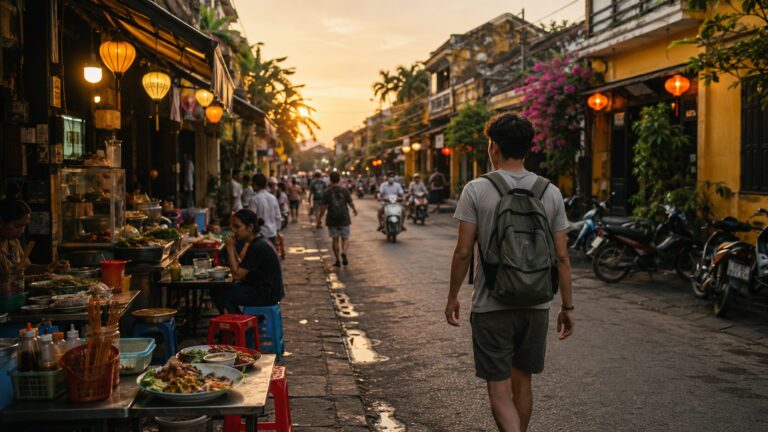
Morning markets in Asian cities operate on a different schedule entirely. In Vietnam, Laos, Cambodia, and Thailand, the market is most alive at 6–8am, when vendors are selling freshly made noodle soups, rice porridge, sticky rice with grilled meat, fresh fruit already cut and bagged. Breakfast from a morning market in any Southeast Asian city is one of the best meals of the day and costs almost nothing. Most travelers sleep through it.
Supermarket strategy deserves its own mention. Supermarkets in Europe especially offer a gap between eating out and cooking from scratch that most travelers underuse: prepared foods — rotisserie chicken, ready-made salads, good bread, local cheese, cured meat — that you assemble into a meal rather than cook. A dinner assembled from a Spanish supermarket — jamón, Manchego, pan con tomate, a piece of tortilla from the deli counter, a bottle of local wine — costs €10–12 for two people and is genuinely better than most €20-per-person tourist restaurants.
The Lunch Rule
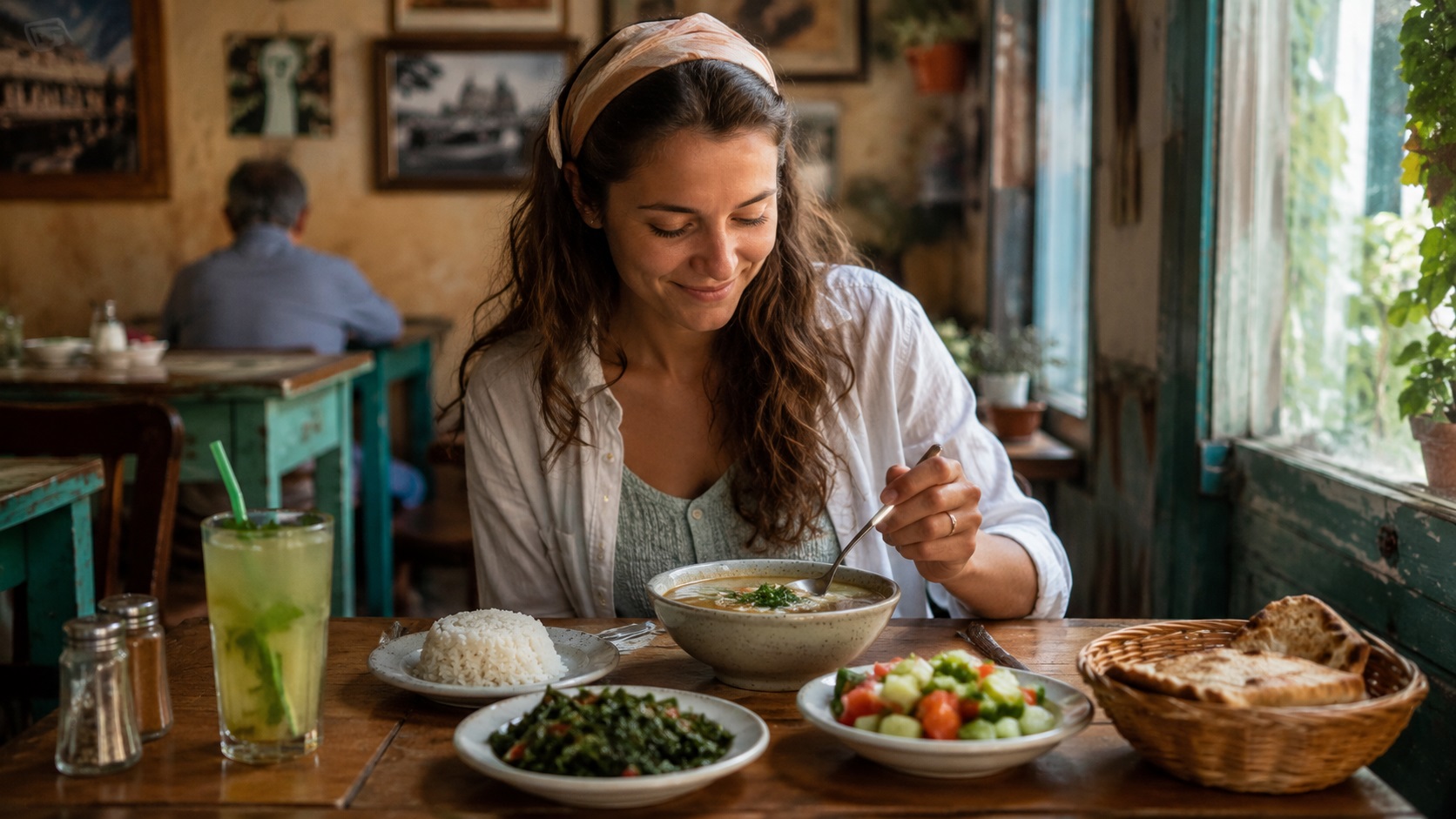
In most of southern Europe, Latin America, and parts of Asia, the main meal of the day is lunch, not dinner. This is not just a cultural observation — it has direct financial implications for travelers.
Many restaurants in Spain, Portugal, France, and Italy offer a set lunch menu — menú del día, menu du jour, pranzo fisso — that includes two or three courses, bread, and sometimes a drink for a fixed price that is typically 40–60% of what the same restaurant charges for dinner. This is how locals eat at restaurants they like. It’s how chefs clear their prep and move through product. And it’s genuinely good food — not a budget version of the menu, but the same kitchen doing what it does well at a price that makes sense for a regular customer.
The practical implication: if you want to eat at a restaurant that’s slightly beyond your normal budget — a place with a Michelin star, a famous chef, a view you’ve been looking forward to — go at lunch. The food is the same. The bill is not.
Make lunch your main meal when you travel and dinner a lighter affair — market food, supermarket assembly, street food — and your food budget drops significantly without any meaningful sacrifice in the quality of what you eat.
Street Food Is Not a Compromise
There is a version of the conversation about street food that frames it as a trade-off: you eat on the street because you can’t afford to eat inside. That framing is completely backwards in most of the world.
In Mexico, the best tacos are not in restaurants. They’re from the taqueria that’s been in the same spot for thirty years, run by the same family, serving the same four things to the same neighborhood customers. The restaurant version exists for people who want air conditioning and a tablecloth. The street version exists because the food is good enough that it doesn’t need either.
In Thailand, the dishes that made Thai food famous internationally — pad thai, som tam, khao man gai, boat noodles — were developed as street food. The high-end restaurants serving them are doing a version; the street vendors are doing the thing itself.
In Istanbul, a simit from a street cart costs almost nothing and is a better breakfast than most hotel buffets. A balık ekmek — a grilled fish sandwich from one of the boats moored by the Galata Bridge — costs €3–4 and is one of the best things you can eat in the city regardless of budget.
The key habits for eating street food well:
Go where there’s a queue. A line of locals waiting for a specific vendor is the most reliable quality signal in food. The vendor with no queue at lunchtime is telling you something.
Look for volume and turnover. A stall that’s cooking constantly, replenishing stock, moving product — that’s fresh food. A stall where the same items have been sitting in a display case for unclear hours is a different proposition.
Watch where the workers eat. Construction workers, market porters, taxi drivers on a break — people doing physical work who eat out every day have strong opinions about value and quality, and they’ve eaten at every option in the area. Where they sit down is where the food is good and the portions are honest.
Drink Less Expensively Without Drinking Less
Drinks are where food budgets go quietly wrong while traveling. Not dramatically, not all at once — just a coffee here, a beer there, a bottle of water every time you’re thirsty, and by the end of the day you’ve spent $25 on liquids without noticing.
Water: Carry a refillable bottle and use it. Most airports have water stations past security. Most hotels and hostels have filtered water available. In cities with safe tap water — most of Western Europe, Japan, Australia, much of North America — drinking from the tap is free. In cities where tap water isn’t safe, large refill stations at convenience stores and pharmacies cost a fraction of individual bottles.
Coffee: The café in the tourist area charges three times what the café two streets away charges for the same espresso. In Italy especially, the rule is universal: standing at the bar costs half what sitting at a table costs. The coffee is identical. The choice is yours.
Alcohol: In most countries, alcohol from a supermarket or off-license costs 20–30% of what it costs at a bar or restaurant. Drinking at bars every night is one of the fastest ways to exceed a travel food budget. Buying a bottle of local wine from a supermarket and drinking it at a viewpoint, in a park, or in a guesthouse common room is cheaper and often more enjoyable.
Juice and soft drinks: Fresh juice from a market vendor is almost always cheaper and better than a bottled soft drink from a tourist café. In Southeast Asia especially, fresh fruit shakes and sugarcane juice cost $1–2 and are worth making a habit of.
The Neighborhood Test
When you arrive somewhere new, the single most useful thing you can do before eating is walk fifteen minutes in any direction away from where you’re staying — specifically away from the main tourist area — and look at what’s there.
Not to eat immediately. Just to look. What restaurants are full? What do the menus look like — photographed dishes aimed at tourists, or handwritten specials aimed at regulars? What are people ordering? Where is the queue?
This fifteen-minute walk gives you better information than most restaurant guides, because it’s specific to the exact neighborhood you’re in right now, and because what you see with your own eyes at 12:30pm on a Tuesday is more current than any review written six months ago.
The restaurants that serve the people who live around you — the office workers, the shopkeepers, the families — are almost always cheaper and better than the restaurants that serve people passing through. They have to be, because their customers come back and have other options.
Cooking When You Can
Not every traveler wants to cook, and not every accommodation makes it easy. But when a kitchen is available — in a hostel, an Airbnb, a vacation rental — using it occasionally changes the economics of a trip meaningfully.
This doesn’t mean cooking every meal. It means: buy coffee and bread for breakfast rather than going to a café. Cook a simple dinner twice a week using local market ingredients. Make lunch to take with you on a day when you’re going somewhere where restaurant options will be overpriced or limited.
The pleasure of cooking with local ingredients is also genuinely part of traveling. Buying produce from a market in Provence and making something simple with it, or assembling a meal from a Vietnamese supermarket in Hanoi, engages with the food culture of a place in a way that eating in restaurants only approximates.
A cheap, lightweight cutting board and a small knife — packed in checked luggage if you’re flying — are the only equipment you need. Everything else is in the kitchen.
When to Spend More
Eating well on a budget doesn’t mean never spending money on food. It means spending it on the right things.
There are meals that are genuinely worth their price: the tasting menu at a restaurant that’s doing something creative with local ingredients, the long lunch at the vineyard, the sushi counter in Tokyo where the chef is making something you couldn’t find anywhere else. These experiences are part of traveling well, not contradictions of traveling cheaply.
The way to afford them is to be disciplined about everything else. If you eat breakfast from a bakery, lunch from a market, and dinner from a street stall or supermarket for six days, you’ve saved enough to have one genuinely splurge-worthy meal without breaking the overall budget. The expensive meal tastes better when you’ve earned it with six days of eating the real thing alongside it.
That balance — careful most of the time, generous at the right moment — is what eating well while traveling actually looks like. It’s not deprivation and it’s not indulgence. It’s paying attention to where the value is and acting accordingly.
Have a destination in mind and not sure where to start with the food? Leave it in the comments and I’ll tell you what I’d prioritize.



One Comment