
What Hotels Are Trying to Do With Upgrades
Before getting into the mechanics, it helps to understand the hotel's perspective. A hotel upgrade is not an act of generosity. It's an inventory management decision. Hotels operate with a range of room types — standard rooms, superior rooms, deluxe rooms, junior suites, suites — at different price points. On any given night, some of those room types will have more inventory than demand. A hotel with twenty standard rooms fully booked and four superior rooms unsold has a specific problem: those four superior rooms will generate zero revenue tonight. Upgrading a standard room guest into a superior room at no charge solves two problems simultaneously. The empty superior room generates some value — even if it's just the goodwill of a guest who leaves a five-star review mentioning they got upgraded — and the hotel recovers some revenue by selling the vacated standard room to a walk-in or late booking. This is the fundamental logic. Upgrades are not a reward for being a nice person. They're a tool for optimizing occupancy across room categories. Understanding this changes how you think about positioning yourself to receive one.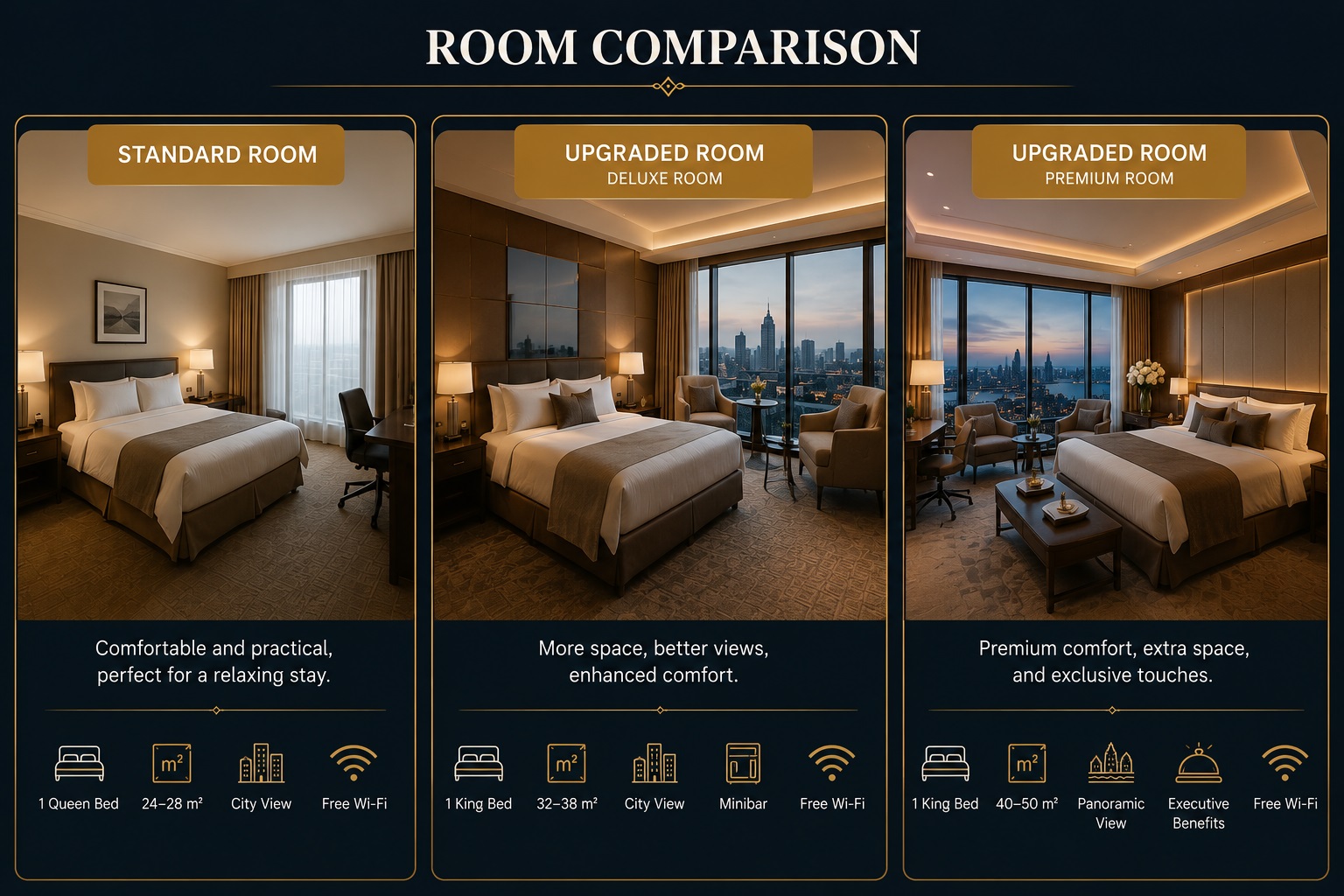
The Role of the Property Management System
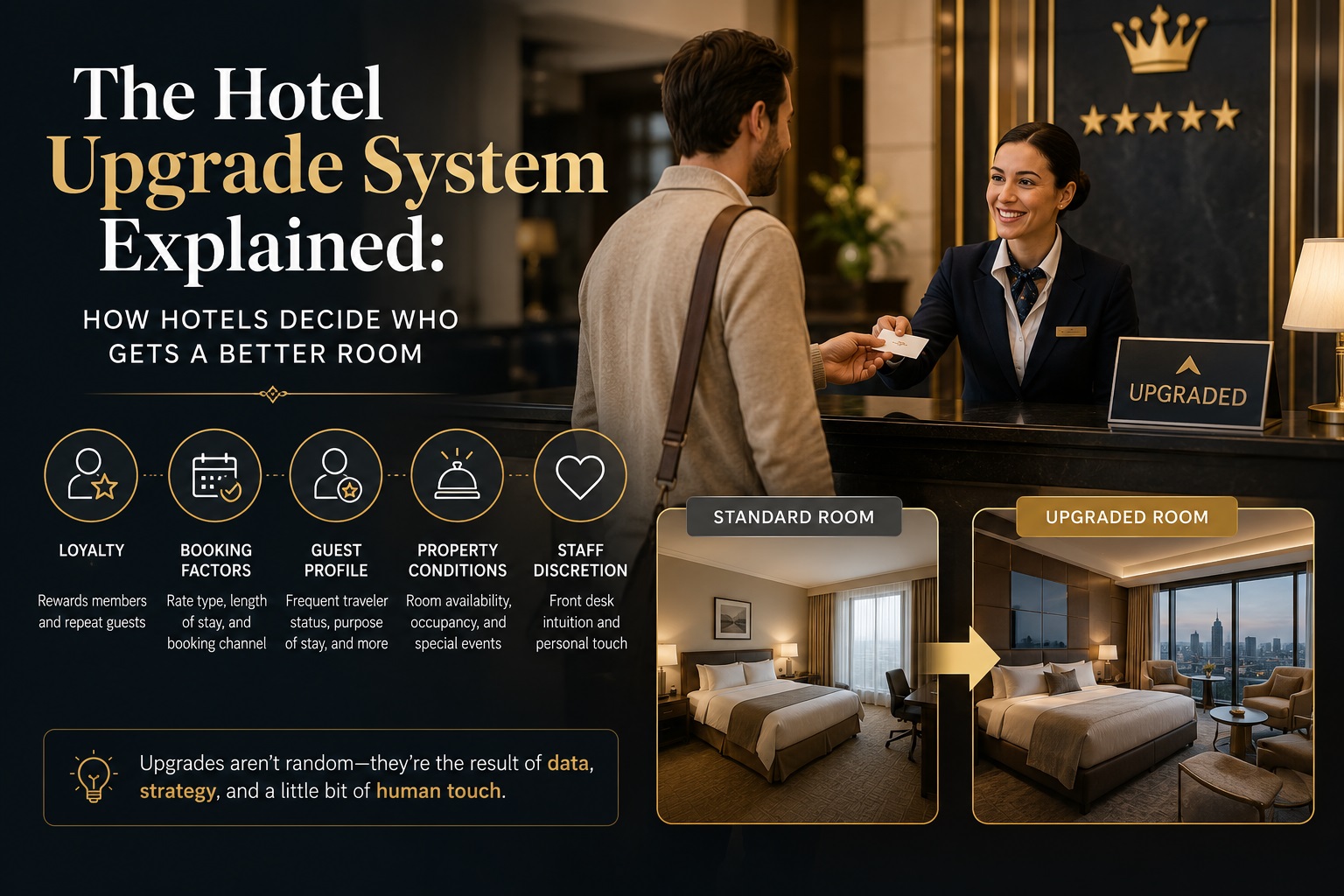
Every hotel of any size runs on a Property Management System — PMS — which is the software that manages reservations, room assignments, check-ins, and guest history. The PMS is where the upgrade decision begins, and it's more automated than most guests realize. On the morning of arrival, a hotel's front office manager or revenue manager looks at the day's arrivals and room availability across all categories. They're identifying gaps — room types that are undersold relative to demand — and the arrivals that are best positioned to fill those gaps via upgrade. The PMS flags guests based on criteria that vary by property but typically include: Loyalty status. This is the most heavily weighted factor at chain hotels. A Marriott Bonvoy Platinum member, a Hilton Honors Diamond, an IHG One Rewards Spire Elite — these guests are flagged by the system and moved to the top of the upgrade consideration list automatically. The loyalty program's terms typically commit the hotel to "room type upgrades when available" for high-status members, which means this isn't even discretionary at the front desk level. It's a commitment the brand has made. Length of stay. Guests staying five nights are upgrade candidates before guests staying one night. A longer-stay guest in a better room generates more potential for positive reviews, more spending at hotel outlets, and more likelihood of returning. The math favors upgrading them. Booking channel. Guests who booked directly — through the hotel's own website or by calling the property — are typically given preference over those who booked through third-party platforms like Booking.com or Expedia. The reason is straightforward: the hotel paid a 15–25% commission on the third-party booking and a near-zero cost on the direct booking. The direct booking guest is more profitable, and the hotel has an incentive to reward that behavior. Rate paid. Counter-intuitively, guests who paid the lowest rates are sometimes more likely to receive complimentary upgrades, because the hotel's revenue management system has already extracted what it can from them and the upgrade costs little in lost revenue. Guests who paid a high rate for a standard room might be offered a paid upgrade rather than a complimentary one, on the theory that they're willing to spend more. Past stay history. The PMS stores your history with the property and the brand. A guest who has stayed twelve times at properties in the chain and spent consistently at the hotel's restaurants and spa is a guest the system recognizes as valuable. That history surfaces at check-in. Special occasions. Honeymoons, anniversaries, birthdays noted in the reservation — these flag the stay as one where a gesture of goodwill from the hotel has outsized emotional impact. Front desk staff are often trained to identify and act on these.How the Front Desk Actually Makes the Call
The PMS does the data work, but the front desk agent makes the final call — and this is where human factors enter the equation. At most hotels, front desk agents have a defined band of discretion. They can upgrade guests within a certain room tier range without manager approval. Beyond that range, they need to escalate. This means that the relationship you build with the agent in the first sixty seconds of check-in matters, not because charm magically unlocks upgrades, but because an agent who's trying to decide between two similarly positioned guests will choose the one they liked. What front desk agents respond to: guests who are patient, polite, not on their phone during check-in, and who engage with the interaction as a conversation rather than a transaction. Asking the agent's name, making brief genuine conversation, asking directly but not demandingly whether any upgrades are available — these things shift the interaction in ways that compound with the underlying system factors. What they don't respond to, or respond to negatively: demanding an upgrade as though it's owed, invoking loyalty status in an entitled way, expressing displeasure with the standard room before they've even seen it, or treating the agent as an obstacle rather than a person with some ability to help. The agent who's feeling pressured or unappreciated reaches for the "no availability" response faster than one who's feeling engaged. The specific ask that works: After exchanging pleasantries and before completing check-in, something like: "I'm really looking forward to the stay — is there any chance of an upgrade if anything's available tonight?" Delivered once, without pressure, and dropped gracefully if the answer is no. The agent knows whether there's availability. The ask signals that you'd appreciate the gesture. The tone signals that you're not going to make their shift difficult if the answer is no. For the full playbook on positioning yourself before and during check-in, see how to get a hotel room upgrade without paying for it.Paid Upgrade Systems: The Bid Model
In the past decade, a significant portion of the hotel industry has moved to formalized paid upgrade programs that operate through bidding systems. If you've received an email a few days before a hotel stay asking whether you'd like to bid on a room upgrade, you've encountered this. We've covered the bidding process in much more detail here: how hotel room bidding actually works and whether it's worth it. The main platforms are Plusgrade, Nor1 (now part of Oracle Hospitality), and Oaky. These are B2B software companies that hotels contract with to manage upgrade inventory and monetize room categories that would otherwise go unsold. How the bidding works: You receive an email — typically two to seven days before arrival — inviting you to submit a bid for an upgrade. The email shows the room categories available and a suggested bid range. You enter a bid amount, provide your card details, and wait. The hotel reviews all bids alongside its occupancy forecast and assigns upgrades to the winning bidders, usually one to three days before arrival. The pricing is opaque by design. You don't know what other guests bid. You don't know the hotel's minimum acceptable price for the upgrade. The suggested bid range in the email is a guidance figure that may or may not reflect what actually wins — some hotels set it conservatively to encourage participation, others set it accurately. What actually wins bids: Generally, bids at the upper end of the suggested range win more consistently than bids at the lower end. Hotels using these systems are trying to maximize revenue per available room; they're not looking for reasons to accept low bids. If the upgrade is genuinely worth it to you, bid near the top of the range. If you're bidding opportunistically, bid toward the bottom and accept that you may not win. When bid upgrades make sense: When the room category you'd be upgrading to represents a genuine quality improvement for your specific stay — a suite with a separate living room for a longer stay, a sea-view room when you specifically wanted the view, a room with a larger workspace if you're traveling for work. When the upgrade is marginal — a superior room that's slightly larger than the standard — the bid price rarely reflects good value. One thing to know: Winning a bid upgrade doesn't preclude also being upgraded by the hotel's complimentary system. In practice, the upgrade you bid on is the floor, not the ceiling, of what you might receive. Some guests bid on a superior room and arrive to find the hotel has put them in a suite on a complimentary basis, using the bid as a data point that the guest was interested in moving up.Suite Upgrades: When They Happen and Why
Suites are a specific category that operates somewhat differently from standard room upgrades. Most suites in a hotel are occupied by guests who specifically booked and paid for them. But most hotels have at least some suite inventory that goes unsold on any given night, and those rooms generate zero revenue empty. Complimentary suite upgrades happen more rarely than standard room upgrades and almost exclusively to: High loyalty status members, particularly those at the top tier of major programs. A Marriott Titanium Elite member has a meaningful chance of a suite upgrade at properties where suite inventory is available. A member with basic status does not. Guests celebrating specific occasions who are noted in the reservation and who have stayed with the brand before. The combination of occasion and relationship history is a strong signal. Direct-booked, longer-stay guests at properties that prioritize occupancy optimization over revenue per room. Boutique hotels and independents are more likely to make this call than major chain properties, which have more rigid revenue management systems. Guests who simply ask directly — not by demanding, but by asking at check-in whether there's any possibility of a suite upgrade tonight. The worst answer is no. The best answer is that someone's preferences aligned with available inventory in a way that worked.The Checkout Side of the Equation
One thing most people don't know: upgrade decisions aren't only made at check-in. Some hotels review occupancy mid-stay and move guests to better rooms if their current room becomes needed for a different booking — particularly if you're a loyalty member or a valuable guest. This is less common than arrival upgrades but happens more often than people realize. The guest who was polite at check-in, who interacted pleasantly with staff, and who is a known brand loyalist is the one who gets the courtesy call saying "we'd like to move you to a nicer room for the remainder of your stay." It's also worth knowing that if your stay overlaps with a sold-out period followed by a quieter period, the room category situation may change during your stay. A direct conversation with the front desk on day two — "is there anything available in a higher category for the rest of my stay?" — is appropriate and occasionally productive at properties where the inventory situation has shifted.What Doesn't Work
For completeness, the things people try that consistently don't: Invoking a competitor's price. "The hotel down the street was the same price and it had a better room" is not leverage. It's a reason to go to the hotel down the street. Complaining about the standard room before checking in. Expressing dissatisfaction as a tactic tends to produce defensive responses from front desk staff rather than generosity. Asking multiple times after a clear no. The first no is final. Pressing further damages the relationship with the agent and reduces the chance of other forms of consideration during the stay. Tipping at check-in in contexts where it's not customary. This works in some markets — it's an accepted practice in parts of the United States and some other countries — and doesn't work in others, where it reads as an attempt to bribe a professional doing their job. Know the cultural context before trying it. Booking through a loyalty program app or third-party site and expecting the same upgrade treatment as a direct booking. As described above, booking channel matters. The system sees it.The Summary Version
Hotels upgrade guests based on a combination of automated system factors — loyalty status, booking channel, length of stay, room category availability — and front desk discretion. The guests who get upgraded most consistently are those with high loyalty status at chain hotels, those who book directly, those who ask pleasantly and only once, and those who stay for multiple nights. The bid upgrade system, now used by a significant portion of the industry, offers a separate path to better rooms that operates transparently and allows anyone to participate regardless of loyalty status. Understanding that upgrades are an inventory management tool rather than a reward for charm means you can position yourself correctly for the factors that actually drive the decision — rather than hoping you happen to catch someone in a generous mood.Staying somewhere soon and want to know whether an upgrade bid is worth it for a specific property, or whether your loyalty status at that brand is likely to help? Drop the details in the comments.


