
The Truth About “Free” Tours and Whether They’re Worth It
The first free walking tour I took was in Berlin, about eight years ago. I was skeptical going in — I’d assumed “free” meant low-effort, forgettable, a box-checking exercise for people who didn’t know how else to start a city. What I got instead was three hours with a guide who knew the city in the way only someone who actually lives there can, who took us through neighborhoods I’d never have found on my own, and who told stories about the Cold War, the Wall, and the city’s reinvention that I still think about when Berlin comes up in conversation.
I tipped €15 at the end and felt like I’d underpaid.
Since then I’ve taken free tours in probably twenty cities across Europe, Asia, and Latin America. Some have been that good or better. A handful have been mediocre. A few have been genuinely bad. And over all of those experiences I’ve developed a clear picture of what free tours actually are, where they work well, where they don’t, and how to tell the difference before you commit three hours of a limited trip to one.
What “Free” Actually Means
The quotation marks around “free” exist for a reason. Walking tours advertised as free are not free — they operate on a tip-based model where participants pay whatever they feel the tour was worth at the end.
The guide earns nothing from the tour company in most cases. Their income is entirely dependent on the tips they collect, which means they have a direct financial incentive to be good. A guide who gives a mediocre tour earns less than a guide who gives an exceptional one. The model creates a self-selection pressure toward quality that hourly-paid guides don’t always have.
The going tip rate varies by city and by how good the tour was. In Western Europe, €10–15 per person is reasonable for a solid tour; €20 for an excellent one. In Eastern Europe and Latin America, the equivalent in local currency tends to be slightly lower. The unspoken expectation in most cities is around €10, and guides who ask directly — some do — will tell you something in that range.
What this means practically: a “free” walking tour that you tip well ends up costing roughly the same as a budget-priced paid tour. The difference is that you pay based on what you received rather than upfront based on what you hoped for.

The Business Model Behind the Guide
Understanding who runs these tours and how the economics work helps set expectations.
Most free walking tours operate through tour companies that act as platforms — they market the tours, handle bookings, and take a cut of the tips, sometimes requiring guides to hand over a percentage of what they collect. The guide keeps the rest.
Some guides are independent operators who use the “free tour” model to build a customer base, collect reviews, and sell premium paid tours on the side. The free city tour is the entry product; a specialized paid tour — a food tour, a street art tour, a specific historical period — is the upsell. This is a legitimate business model and doesn’t make the free tour worse; it just means the guide has additional incentives beyond the tip.
A smaller number of free tours are genuinely guide-led without a company structure behind them — someone who loves their city, started giving tours as a side project, and built a reputation through reviews and word of mouth. These are often the best tours you’ll take, because the guide is doing it out of genuine enthusiasm rather than because it’s their assigned shift.
The practical implication: the company brand behind a tour tells you less than the individual guide’s reviews. Before booking any free tour, look at reviews on TripAdvisor, GetYourGuide, or Google, and look for reviews that mention the guide by name. A tour company with hundreds of five-star reviews for a guide called Maria or Jonas is a better signal than a company with good overall scores but no individual names attached.
Where Free Tours Work Exceptionally Well
Not every city or context is equally suited to the free tour model. The places where it consistently works best share a few characteristics.
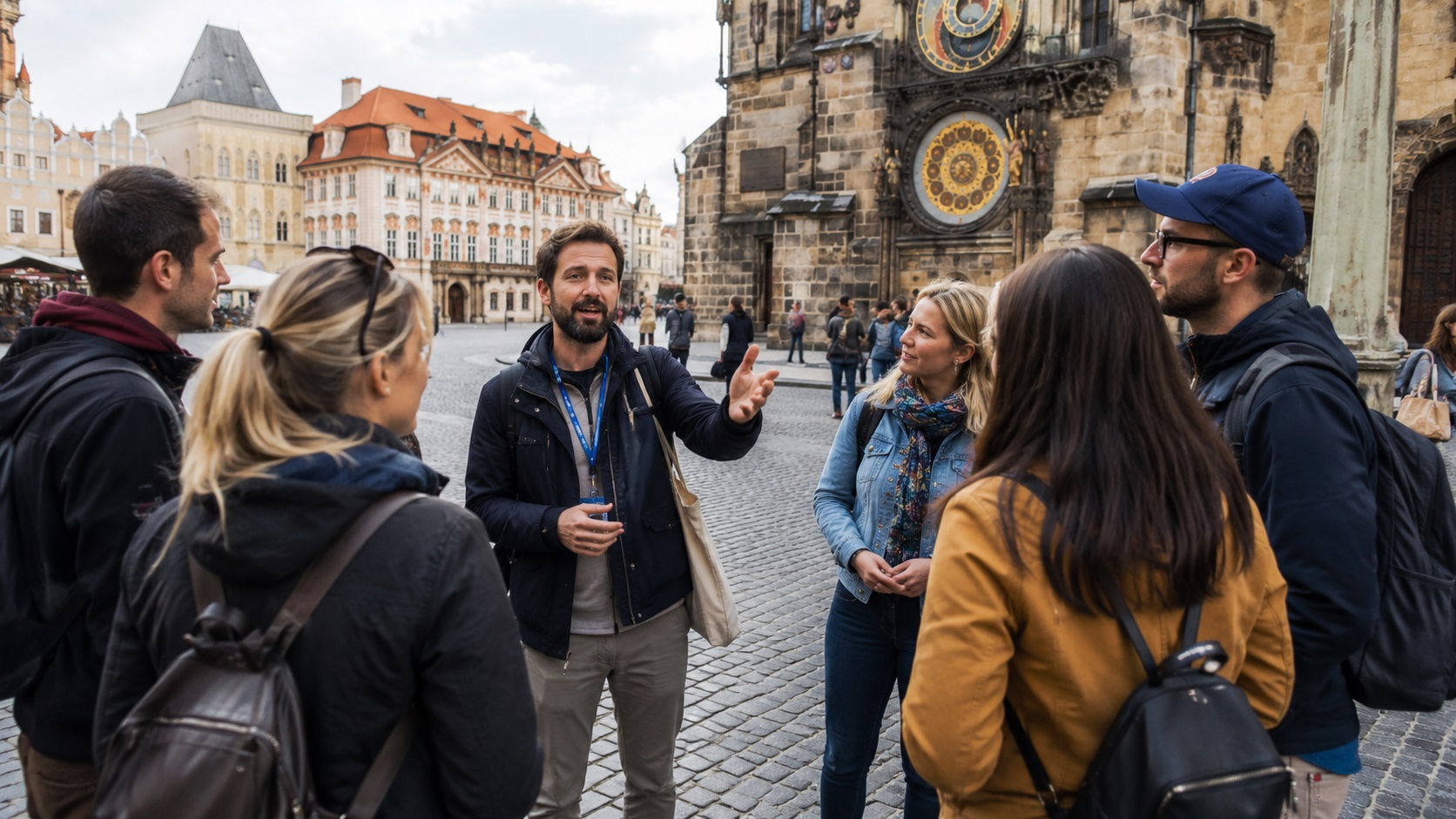
Cities with rich, complex histories that benefit from narrative rather than self-guided reading. Berlin is the standout example — the layers of the city’s 20th-century history, from Weimar to Nazi Germany to division to reunification, are almost impossible to absorb from plaques and audio guides alone. A good guide who can connect the physical space to the historical narrative changes what you see. The same is true of Prague, Warsaw, Budapest, and Kraków — cities where the history is dense, often dark, and deeply embedded in the streets you’re walking.
Cities where orientation genuinely matters. Arriving somewhere and immediately understanding the layout — where the neighborhoods are, how they relate to each other, which areas are worth spending time in versus which are tourist-only surfaces — is a specific service that walking tours provide better than any map. A two-hour free tour on your first day in a new city is often the single most useful two hours of the trip, regardless of whether the historical content is exceptional.
Cities with strong guide communities. Some cities have developed reputations for particularly good free tour guides — people who’ve been doing it for years, who’ve built audiences, who compete with each other in ways that keep quality high. Barcelona, Lisbon, and Edinburgh consistently produce strong tours. Others have thinner guide communities where the quality is more variable.
How to Eat Well While Traveling Without Spending a Fortune
Where Free Tours Are Less Reliable
Very popular tourist cities where the model has been saturated. In cities like Rome, Paris, and Amsterdam, the free tour market is large enough that quality varies enormously. The best guides in these cities are exceptional; the worst are people who learned a script and have been reciting it for three months. The ratio of good to mediocre is lower than in cities where the free tour culture is newer and the guide community is smaller.
Small or less-visited cities where the guide pool is thin and reviews are limited. A free tour in a mid-sized regional city with four reviews and no named guide is a gamble. Sometimes it pays off — the local who started giving tours because they wanted to share their city with visitors is often passionate and interesting. Sometimes it doesn’t — the person who signed up for a tour company gig without much investment in making it good is also possible.
Anywhere the tour is clearly a vehicle for something else. Some “free tours” are marketing exercises for shops, restaurants, or attractions. The guide takes you to specific stops that are paying for the placement. This isn’t always disclosed, and the tour’s agenda becomes clear about halfway through when you’ve been brought to the third “recommended” shop. Reviews usually identify these; look for any mention of commercial stops or pressure to spend money during the tour.

Paid Tours vs. Free Tours: The Honest Comparison
The implicit assumption in most travel advice is that paid tours are better than free ones because you get what you pay for. The reality is more complicated.
Paid tours have advantages: Smaller groups (usually), more specialized content, guaranteed guide quality because the company vets its guides more carefully when they’re charging for them, and logistics that are often more organized — tickets pre-purchased, transport included, etc.
Free tours have advantages: Larger group size forces the guide to develop stronger public speaking and crowd management skills. The tip model rewards personality and engagement in ways that a fixed salary doesn’t. And the price-at-end model means you’re paying for what you received, not what was promised.
In practice, the best free tour I’ve taken was better than most paid tours I’ve done, and the worst free tour I’ve taken was worse than any paid tour. The variance is higher. The average, based on my experience, is roughly comparable.
The decision rule I use: for a general city orientation or a history-focused walking tour, try the free tour first. If it’s excellent, you’ll have tipped generously and gotten great value. If it’s mediocre, you haven’t lost much. For specialized content — a food tour, a specific museum tour, an architecture tour that requires pre-booked access to specific places — a paid specialist tour is usually the better investment.
Group Size: The Variable That Affects Everything
One of the most consistent predictors of free tour quality is group size, and it’s one you often don’t know until the tour begins.
A free tour with eight people is an intimate experience where you can hear the guide clearly, ask questions, follow naturally, and have something close to a conversation. A free tour with forty-five people is a different thing entirely — you’re at the back straining to hear, the guide is managing logistics rather than storytelling, and the experience has more in common with being herded than being shown around.
Free tours in popular cities during peak season routinely exceed thirty people. Some guides manage this well — they have microphone systems, they’re practiced at projecting, they break large groups into subgroups. Others don’t, and a large group with an underpowered guide is a genuinely frustrating experience.
Ways to manage this: book early in the morning, when tours are typically smaller than afternoon ones. Book on a weekday rather than a weekend. Check reviews specifically for comments about group size. If you arrive and the group is clearly too large for the format, it’s acceptable to quietly leave and find an alternative.
The Tip Conversation: How Much and How to Handle It
The tipping moment at the end of a free tour is the one that makes most people slightly uncomfortable, particularly in cultures where tipping isn’t standard. A few things worth knowing.
The guide will usually give a brief speech at the end about the tip-based model — explaining that this is how they earn their living, sometimes suggesting a range. This is not aggressive; it’s part of the model and everyone present knows how it works.
Tip based on what you received, not on a fixed formula. A mediocre two-hour tour that covered content you could have read on Wikipedia in twenty minutes is worth less than an extraordinary three-hour tour that changed how you understand the city. The tip model is designed to reflect this, and guides who give good tours expect — and receive — proportionally more.
The practical range for Western Europe in 2025: €10 is baseline for a solid tour. €15–20 for a tour you genuinely learned from and enjoyed. More than that if it was exceptional and you can afford it. In Eastern Europe and Latin America, adjust downward slightly to local cost-of-living equivalents.
Pay in cash. Guides don’t always have card readers, and the tip-at-the-end moment doesn’t lend itself to fumbling with payment apps.
Specialized Free Tours: A Different Category
Beyond the standard city walking tour, a category of more specialized free tours has developed in many cities that’s worth knowing about.
Street art and graffiti tours in cities like Berlin, Bristol, Lisbon, and Melbourne. These are usually guide-led and free, run by people who are embedded in the local art scene and can contextualize what you’re looking at in ways that a self-guided walk with a map cannot.
Dark tourism tours — focused on difficult history, crime, or tragedy — in cities like Prague, Berlin, Warsaw, and Medellín. These tend to attract guides with deep knowledge of specific historical periods and a genuine investment in making sure visitors understand rather than just observe.
Food market tours that are technically free but clearly designed to introduce you to vendors the guide has relationships with. These sit in a gray area — the commercial element is real, but the content is often genuinely interesting, and buying something from a market you were shown is not the same as being pressured into a shop. Worth taking with clear eyes about what they are.
Neighborhood-specific tours that cover a single district in more depth than a city-wide tour can. These are increasingly common in cities with distinct neighborhood cultures — Kreuzberg in Berlin, Bairro Alto in Lisbon, Gracia in Barcelona — and often better than the general tour because the guide knows one area very well rather than everything moderately.
How to Find the Good Ones
The difference between a memorable free tour and a forgettable one comes down almost entirely to the individual guide. Here’s how to find the right one.
Read reviews on multiple platforms and look for named guides. A guide mentioned by name across dozens of reviews — “ask for Carlos,” “the tour with the woman in the red jacket” — is a guide who’s built a real reputation. Book specifically for them if the platform allows it.
Check the tour’s TripAdvisor rating, not just the company’s. Individual tour ratings are more useful than company ratings because companies run multiple tours with multiple guides.
Ask at your accommodation. Hostel staff and hotel concierges who actually know the city — not the ones who are being paid to recommend specific tours — will tell you which tours are genuinely good. “Which free tour would you take yourself?” is the right question.
Book the morning tour rather than the afternoon one. Morning tours are smaller, the city is quieter, and the light is better for the walks between stops.
Start with a city where free tours have strong reputations. If you’re new to this format and want to be confident it’s worth your time: Berlin, Lisbon, Kraków, Edinburgh, and Buenos Aires consistently produce excellent free tours. If your first experience is in a city where the quality is more variable, your impression of the format may be unfairly shaped by a single bad experience.
How to Travel Europe for Under $60 a Day (Realistically)
Free tours are worth taking in most cities you visit, with appropriate calibration of expectations.
They are not truly free — the tip model is a payment system where you pay based on quality received rather than upfront. For a good tour in Western Europe, expect to pay €10–15. For an exceptional one, more.
The best free tours are among the most valuable travel experiences available at any price. A guide who knows their city deeply, tells stories that connect places to history, and creates a sense of orientation that lasts for the rest of your trip is worth significantly more than the tip rate suggests.
The worst free tours are two hours of your limited trip that you won’t get back. The way to avoid them is to spend fifteen minutes reading recent reviews before booking rather than picking the first result that appears.
Do that, and the odds are strongly in your favor.
Heading somewhere specific and wondering whether the free tour is worth it there? Drop the city in the comments and I’ll tell you what I know.