What Nobody Tells You About Traveling to Morocco
I nearly didn’t go to Morocco. I’d read enough contradictory accounts online — “it’s magical,” “it’s exhausting,” “the medinas are overwhelming,” “the people are incredibly kind,” “the touts won’t leave you alone” — that I couldn’t form a clear picture of what actually waiting on the other side of the flight. Eventually a friend who’d been three times told me to stop reading and just go.
She was right that I should go. She was also right, in retrospect, that most of what I’d read hadn’t prepared me for what Morocco actually is. Not because it’s dangerous or difficult in the ways people fear, but because it’s specific in ways that general travel writing tends to sand down. The country is genuinely unlike anywhere else I’ve traveled — not just visually, but in how it operates, how it feels to move through it, and what it asks of you as a visitor.
This is the guide I wish I’d had before my first trip. Not a highlights list — plenty of those exist — but an honest account of the things that catch first-time visitors off guard and the things that make the difference between finding Morocco exhausting and finding it extraordinary.
The Medinas Are Designed to Disorient You — and That’s the Point
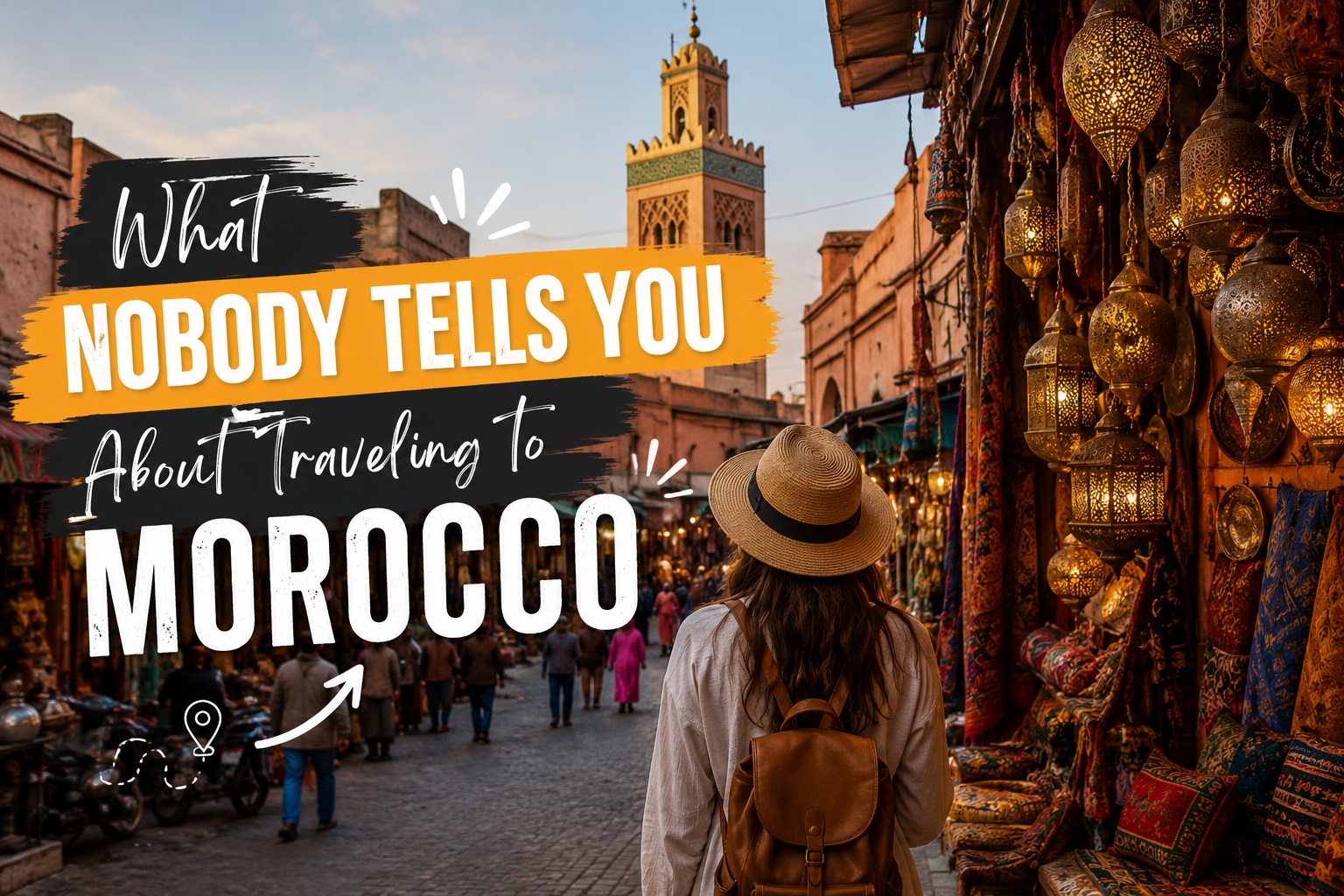
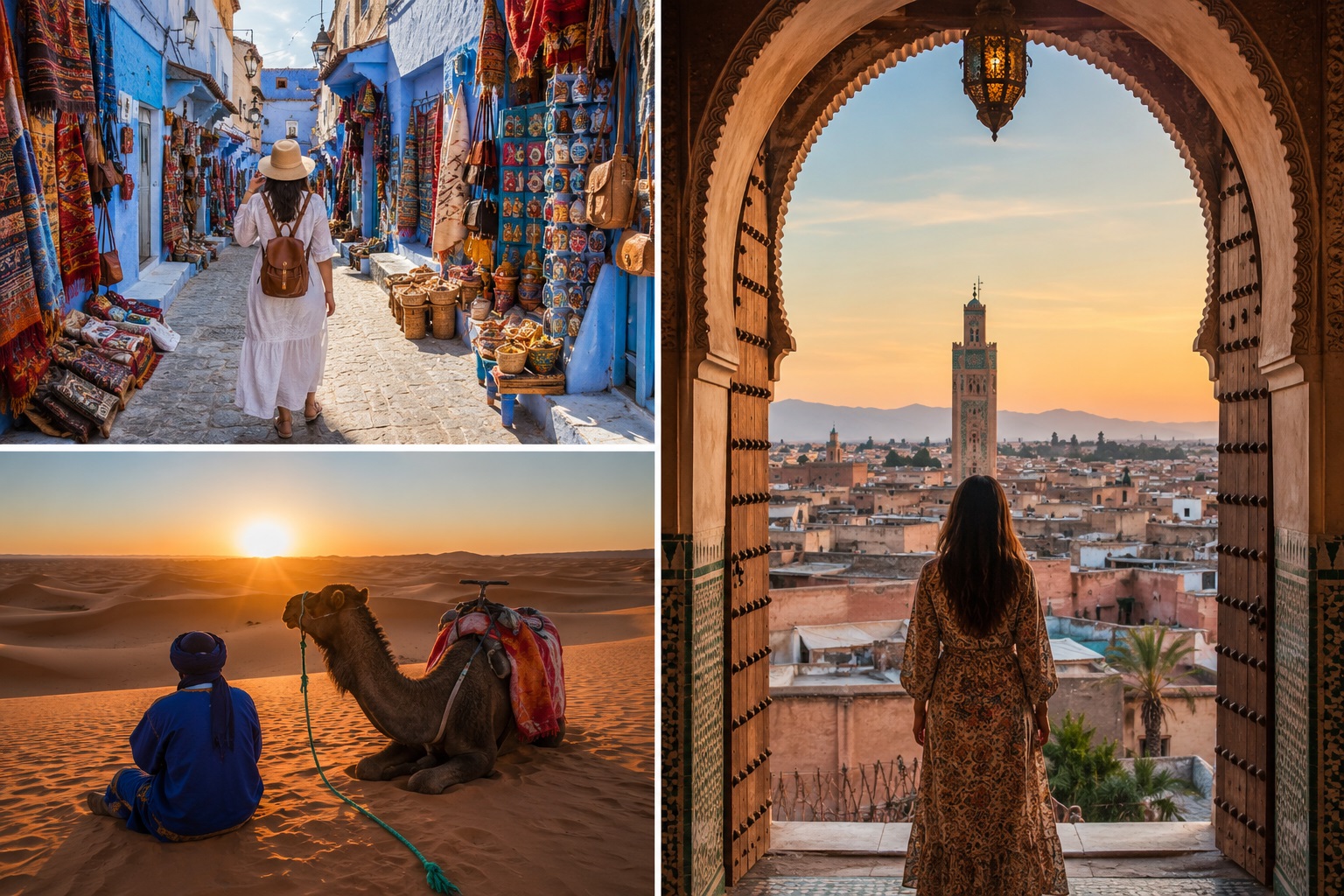
Every major Moroccan city has a medina: an ancient walled city of narrow, winding lanes that predate any concept of urban planning as Westerners understand it. Fes el-Bali, the old medina in Fes, is the largest car-free urban area in the world. Marrakech’s medina has streets so narrow that two people with bags can barely pass each other. Both of them will, on your first day, make you feel completely and genuinely lost.
This is not a bug. It’s the fundamental character of the place.
The medinas were built over centuries without a grid, without consistent street widths, without signage, and in many cases without through-routes that make intuitive sense to anyone who didn’t grow up navigating them. The streets branch and turn and double back in ways that confound any internal compass. You will get lost. You will walk in circles. You will emerge from a lane you thought led somewhere useful into a dead end, turn around, and walk back through the tanneries you passed twenty minutes ago.
The travelers who love the medinas are those who make peace with this early. Not knowing exactly where you are in Fes — genuinely not knowing, for hours at a time — is one of the more vivid travel experiences available anywhere. There is always another alley, another sound, another smell of cumin and cedar and tanned leather. The medina rewards aimlessness in a way that almost no modern city does, because it was never designed for purposeful navigation in the first place.
Bring a downloaded offline map (Maps.me covers the medinas better than Google Maps in many cases), know roughly where your riad is, and then put the phone away and walk.
Riads Are Worth the Premium
The standard accommodation in a Moroccan medina is a riad: a traditional house built around a central courtyard, typically with a fountain, mosaic tilework, carved plaster walls, and rooms arranged on multiple floors around the interior space. From the street, riads are invisible — you pass a plain wooden door in a blank wall with no indication of what’s behind it. Inside is frequently stunning.
Staying in a riad rather than a standard hotel is one of the most significant decisions you can make for the texture of a Morocco trip. You wake up to the sound of a fountain in a tiled courtyard, have breakfast on a rooftop terrace looking over the medina roofscape, and have a home base that feels genuinely connected to where you are rather than a room that could be anywhere.
The price range is wide. Basic riads run $50–80 per night. Mid-range properties with attentive service and beautiful restored interiors run $100–160. The top end — full restoration, pool, exceptional food — runs $200–400. At almost every price point, the riad experience beats a standard hotel of equivalent cost in how it makes a Morocco trip feel.
Book early, particularly for Marrakech in peak season. The well-regarded riads in the best medina locations fill months in advance. Reading recent reviews on Booking.com and TripAdvisor before committing matters here more than almost anywhere else, because the gap between a beautifully maintained riad and a poorly managed one with nice photos is significant.
One practical note: reaching your riad on arrival can be complicated. Medina addresses are often approximate, GPS doesn’t reliably navigate the lanes, and your luggage will need to be carried if the car can’t get close. Most riads will send someone to meet you at a medina gate if you coordinate in advance — do this.
The Guide Question: What You Actually Need
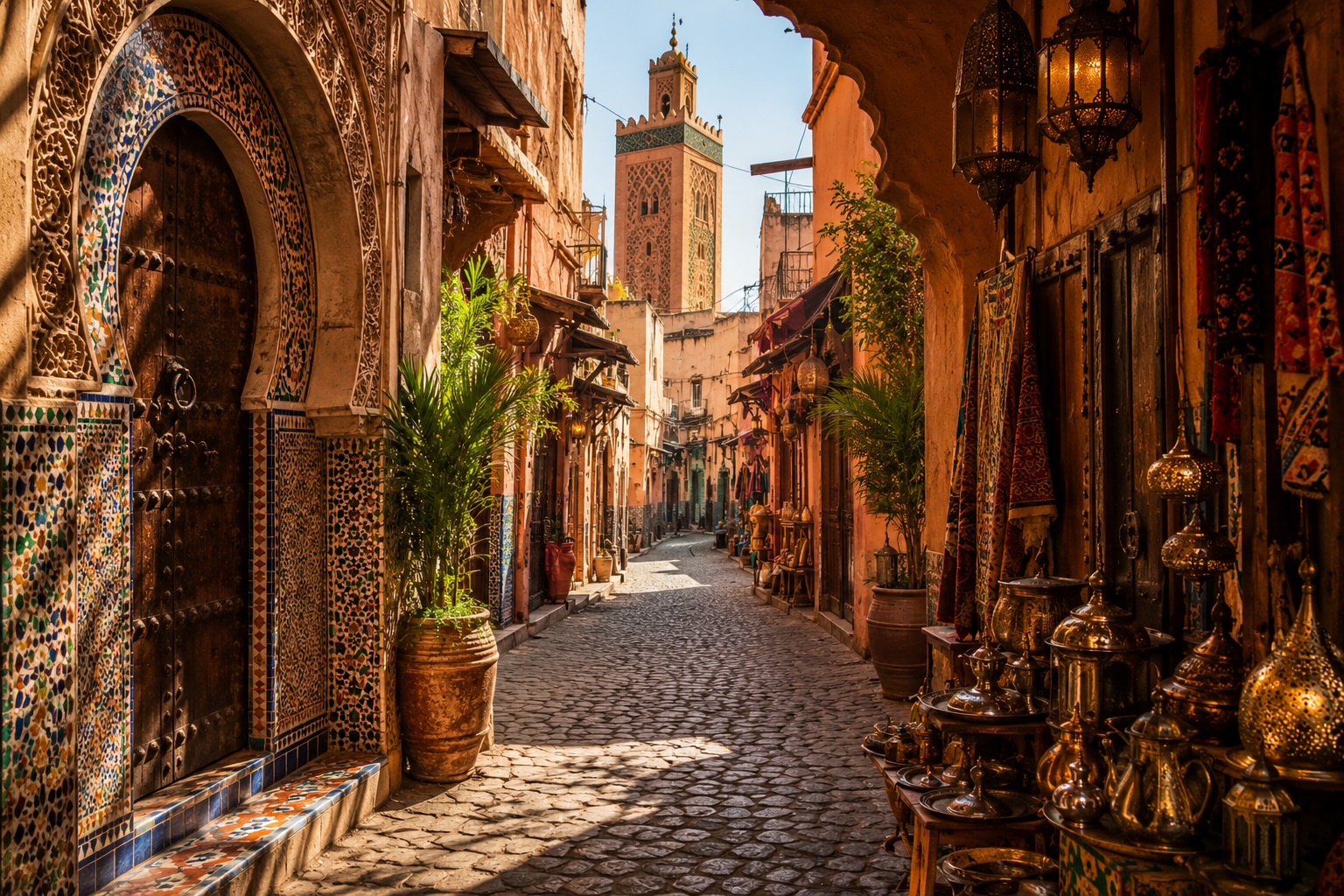
Every first-time visitor to Morocco faces the guide question sooner or later, usually within twenty minutes of entering a medina for the first time. Someone will offer to show you around. The offer will be warm, confident, and apparently spontaneous. It will not be spontaneous.
Unofficial guides — men who approach tourists and offer orientation in exchange for tips — are a feature of Moroccan medina life that’s been operating for generations. Some are genuinely helpful and knowledgeable. Some will lead you on a tour that ends at a carpet shop, a leather goods store, or an argan oil cooperative where a commission awaits. The line between a local being friendly and a local running a gentle hustle is blurry enough that it’s hard to know which you’re dealing with until you’re already in the shop.
The options:
Hire an official guide through your riad or a licensed agency for a half or full day. Official guides are government-licensed, trained in the history and culture of the medina, and not permitted to take commissions from shops. They’re expensive relative to the unofficial alternative — typically $30–60 for a half-day — but they provide genuinely good information and eliminate the shop-commission dynamic entirely. For a first day in Fes especially, a half-day with a good official guide is worth the cost.
Navigate independently after the first day or two, once you have a feel for the medina’s structure and your bearings. Most of what you want to see is findable without a guide, and the experience of getting there yourself is part of the point.
Be politely clear with unsolicited offers. “No thank you, I’m fine” said once, without engagement, and continued walking works better than hesitation, explanation, or negotiation. Engaging with a persistent approach, even to decline multiple times, signals that you might eventually agree. One clear response and continued movement signals that you won’t.
Negotiation Is Part of the Economy — But It Has Rules
Morocco operates on a negotiation culture for much of its retail economy, and visitors who don’t know this pay significantly more than they need to. But negotiation in Morocco has its own etiquette, and understanding the rules makes it more effective and more pleasant.
Fixed prices exist and should be respected. Supermarkets, pharmacies, official stores, and many restaurants have fixed prices. Attempting to negotiate at a restaurant or a large retailer is inappropriate and won’t work. The negotiation culture applies to souks, markets, and smaller shops where prices are not displayed.
The opening price is theater. The first price a vendor names in a souk is almost never close to what they’ll accept. The standard dynamic is an opening price, a counter from you at roughly half or less, a rejection, a back-and-forth, and a resolution somewhere in the middle. Neither side is being dishonest — this is the established form of the transaction.
Don’t start negotiating if you’re not willing to buy. Beginning the back-and-forth and then walking away when you’ve reached a fair price is considered rude. Have a rough sense of what you’d pay before you engage.
Knowing prices in advance helps enormously. A few minutes on Google before you go souvenir shopping — “how much does a Moroccan leather bag cost in Fes” — gives you a reference point. The souks are designed to make it hard to compare prices between vendors; knowing the approximate fair market price going in removes much of that disadvantage.
“Fixed price, no negotiation” is a phrase some vendors use to indicate the price is already good. It’s sometimes true and sometimes a negotiation tactic. Reading the context helps.
The Food Nobody Warned You Was This Good
Moroccan food is one of the most consistently underestimated cuisines in the world, partly because its best versions are rarely replicated well outside the country and partly because most tourism-facing writing describes it in terms of the classic dishes without conveying how good those dishes actually are when made properly.
Tagine is the dish most associated with Morocco — a slow-cooked stew of meat or vegetables in a conical clay pot. The tourist versions served in most medina restaurants range from fine to bland. The versions cooked by Moroccan families or in the small local restaurants away from the tourist circuit — lamb with preserved lemon and olives, chicken with apricots and almonds, kefta with egg in a tomato sauce — are genuinely extraordinary. The difference between a tagine made for tourists and one made for Moroccans is significant enough to make the effort to find the latter worthwhile.
Bissara is the breakfast that most visitors never find: a thick soup of dried fava beans or split peas, served with olive oil, cumin, and paprika, with bread for dipping. It costs almost nothing, is eaten early in the morning from small local stalls, and is one of the most satisfying breakfasts you’ll have anywhere. Finding it requires going to the edge of the medina where the stalls serve the morning workers rather than staying where tourists eat.
Street food in Djemaa el-Fna in Marrakech — the main square that fills with food stalls at dusk — is worth knowing the rules of. The spectacle is real and the atmosphere is extraordinary, but the prices are not the prices of street food. The stalls are aimed at tourists and priced accordingly. Eat there once for the experience; find a local restaurant for your other dinners.
Mint tea is a ritual, not a beverage. When someone offers you mint tea in Morocco — a shopkeeper, a host, someone you’ve met — accepting it does not obligate you to buy anything. It’s an expression of hospitality that predates the tourist economy and is genuine even when it comes from a carpet shop. The tea is poured from a height to create froth, served very sweet, and drunk in small glasses. Refusing it is considered rude; accepting it is just good manners.
Morocco’s Physical Diversity Is Shocking If You’re Not Expecting It
Most first-time visitors picture Morocco as medinas and desert. The reality is a country with an extraordinary range of landscapes that takes most people completely by surprise.
The High Atlas Mountains rise to over 4,000 meters south of Marrakech and contain trekking routes, Berber villages, ski resorts, and scenery that has nothing to do with the desert postcards. A day trip from Marrakech to the Ourika Valley gives you a glimpse; a few days in the mountains around Imlil or Toubkal gives you something genuinely different from anything else in the country.
The Atlantic coast — Essaouira, Agadir, the surf towns further north around Taghazout — is cool, windy, and completely unlike the desert interior. Essaouira in particular is one of the most beautiful small cities in Morocco: a whitewashed fortified port city with a strong wind, a relaxed creative atmosphere, and a medina that’s manageable enough to feel like a pleasure rather than a challenge.
The Saharan south — the dune fields around Merzouga and M’Hamid — is what many visitors come for and is genuinely spectacular, but it’s a long way from Marrakech or Fes. The drive is part of the experience: through the Atlas, through the Draa Valley with its ancient palmeries and kasbahs, gradually into the desert proper. Don’t fly over it.
The north coast and the Rif Mountains around Chefchaouen — the famous blue city — offer another landscape entirely. Chefchaouen is heavily touristed now but still beautiful, particularly in the early morning before the day’s visitors arrive. The Rif itself is spectacular and almost entirely unvisited.
Harassment, Scams, and the Honest Picture
Morocco has a reputation for persistent hustlers and tourist scams that is more outdated than current, but not entirely wrong. Here’s an honest account.
Street harassment varies significantly by location and gender. Women traveling alone in Morocco, particularly in Fes and Marrakech, will experience more unwanted attention than men. This is real and worth preparing for. The same tactics apply as elsewhere: confidence, directness, no engagement beyond a single clear refusal, and moving on without making eye contact. Most of it is verbal. Physical harassment is uncommon but not unknown. Traveling with someone else reduces it significantly.
The most common scams targeting tourists in Morocco:
The “your riad is closed / flooded / changed address” approach: someone near a medina gate tells you the place you’re looking for is closed and offers to take you somewhere else. The place you’re looking for is almost certainly open. Check your booking confirmation and proceed.
The “free tour” that ends at a relative’s shop: covered above. One clear refusal is enough.
The snake charmers and henna artists on Djemaa el-Fna: engaging — looking, standing nearby, allowing any physical approach — means you’ll be asked to pay. If you want the photo, know you’ll pay for it and agree on a price first.
None of these are dangerous. They’re the ordinary friction of traveling somewhere with a significant tourism economy and a population that’s learned, over generations, to navigate that economy. Understanding what they are reduces the stress they can cause.
Practical Things Worth Knowing
Dress code: Morocco is a Muslim country with conservative dress norms outside tourist areas, particularly outside major cities. Covering shoulders and knees in medinas and smaller towns is appropriate and appreciated. On beach towns like Agadir and Essaouira, Western resort wear is standard.
Currency: The Moroccan dirham (MAD) is not freely convertible outside Morocco. Bring euros or dollars to exchange on arrival; ATMs are available in cities and give good rates. Many tourist businesses accept euros; paying in dirhams is generally better value.
Transport between cities: CTM and Supratours buses are reliable, cheap, and comfortable between major cities. Train service covers the main northern corridor (Tangier–Casablanca–Marrakech) efficiently. Shared taxis (grand taxis) connect smaller towns and are cheap but require flexibility on timing.
Language: Arabic and Amazigh (Berber) are the national languages. French is widely spoken in cities and is the most useful second language for visitors who have it. Darija — Moroccan Arabic — is its own dialect that differs significantly from standard Arabic. Spanish is useful in the north. English is increasingly spoken in tourist areas but shouldn’t be assumed elsewhere.
Safety: Morocco is broadly safe for tourists. The terrorism threat level has been elevated in the region but incidents specifically targeting tourists are rare. Petty theft exists, as in any country with significant tourism and economic inequality. Standard precautions — don’t leave valuables visible, be aware in crowds — apply.
The Thing That Stays With You
Every traveler who goes to Morocco comes back with a different version of what the country is. The one who arrived in Marrakech in August and spent three days fighting off touts in the heat has a completely different Morocco from the one who spent a week in Fes in October with a good guide and a quiet riad. Both accounts are accurate. Neither is complete.
What tends to stay with people — across the differences in experience and expectations and luck — is something about the sensory density of the place. The sound of the call to prayer echoing across a medina rooftop at dawn. The smell of leather and cumin and woodsmoke. The tile work in a riad courtyard that someone spent months getting right. The hospitality that appears without warning, in a glass of mint tea or a stranger’s directions, and is genuine in a way that changes how you feel about the place.
Morocco is not easy in the way that, say, Portugal or Japan is easy. It asks something of you. But what it gives in return is not available anywhere else.
Going to Morocco for the first time and not sure where to start? Drop your questions in the comments — city choice, itinerary length, what to prepare for — and I’ll give you the honest answer.