

Bali: The Island That Has Everything, Including Everyone Else
Let's start with the thing that shapes every other thing about visiting Bali: it is very, very popular. Bali receives millions of international visitors per year and has built an infrastructure around tourism that is, in practical terms, almost absurdly convenient. You can find excellent food, reliable Wi-Fi, a great yoga class, a driver who speaks English, a villa with a private pool at three different price points, and a beach club with a DJ set on most stretches of the southern coastline. The tourist infrastructure is so well developed that it's possible to spend two weeks in Bali and never feel any friction at all. Whether that's a selling point or a problem depends on who you are.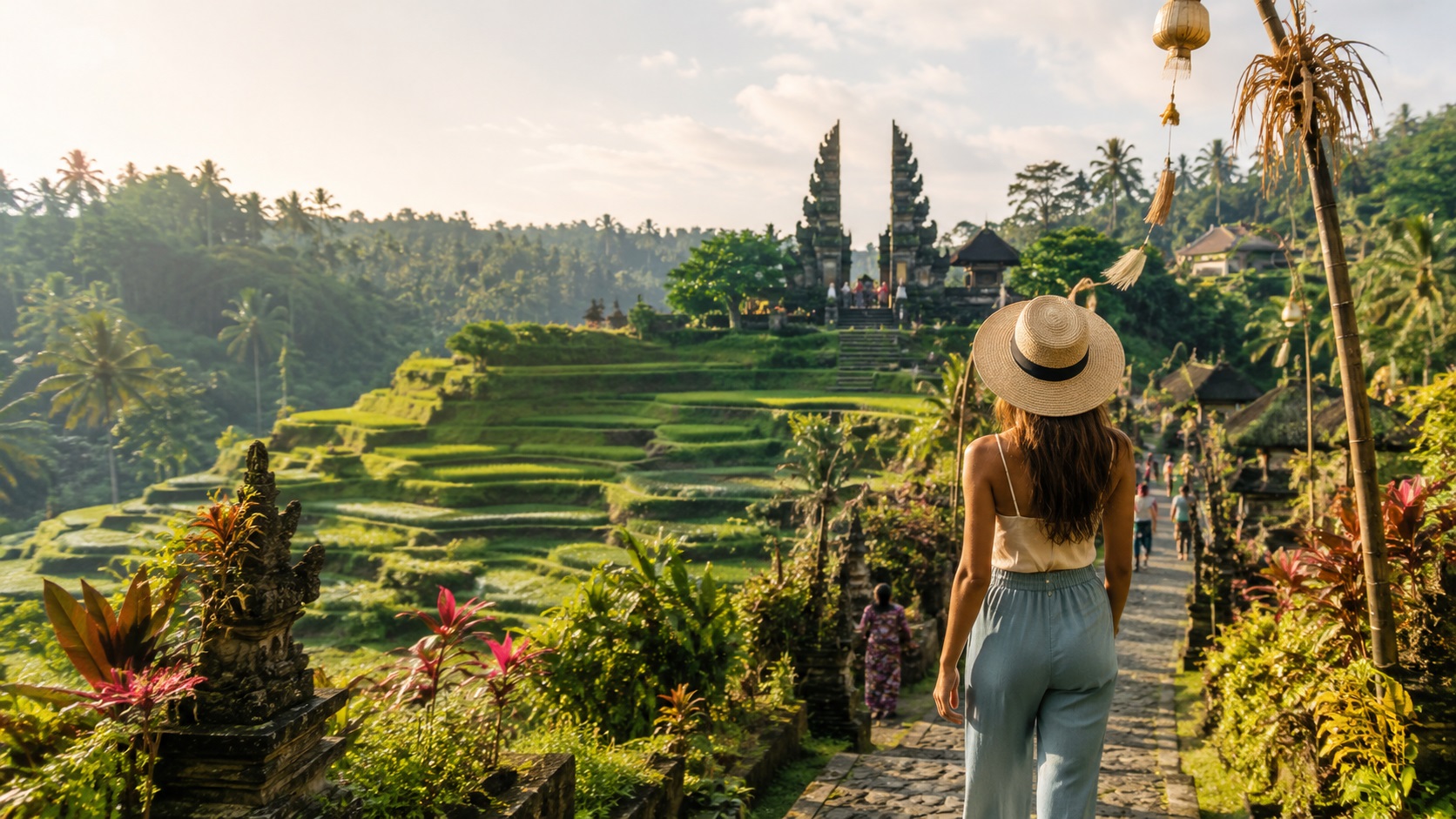 The south — Seminyak, Canggu, Kuta, Nusa Dua — is where most of the tourist infrastructure lives, and it's genuinely international in a way that has little to do with Indonesia specifically. Canggu especially — the neighborhood that's become the default base for digital nomads, surfers, and people who want good coffee and a pool — could be a trendy neighborhood in any prosperous beach city. The food is excellent. The cafés are great. The beach is fine. The feeling of being somewhere specifically Indonesian is largely absent.
Ubud is different. Thirty minutes north of the southern beach strip, Ubud is Bali's cultural center — the place where the island's Hindu traditions, art, dance, and craft culture are most concentrated and most legible to visitors. The rice terraces of Tegallalang are genuinely beautiful, though genuinely crowded. The morning market near the central palace is worth the early alarm. The traditional performances — Kecak fire dance, Legong — are tourist-facing but preserve real art forms. And the surrounding villages, explored by scooter on a quiet Tuesday morning, offer a version of Bali that looks like the photographs that made people want to come in the first place.
What Bali does well: Everything logistical. Getting from the airport to your accommodation is easy. Finding good food at every price point is easy. Moving around by scooter or driver is easy. There are excellent surf breaks, a functioning spa industry, a coffee scene that would be credible in Melbourne or London, and enough variety between the south and the interior that you can calibrate how much tourist infrastructure you want in your daily experience.
What Bali has lost: The feeling of discovery. In the most visited areas, the island has been so thoroughly shaped by the tourism economy that it can feel like a very good product rather than a place. The Instagrammed rice terrace has a ticket booth and a queue. The "hidden waterfall" has a car park. The "local warung" has an English menu and credit card facilities. None of this is dishonest — Bali is genuinely beautiful and genuinely worth visiting — but the expectation management matters.
The south — Seminyak, Canggu, Kuta, Nusa Dua — is where most of the tourist infrastructure lives, and it's genuinely international in a way that has little to do with Indonesia specifically. Canggu especially — the neighborhood that's become the default base for digital nomads, surfers, and people who want good coffee and a pool — could be a trendy neighborhood in any prosperous beach city. The food is excellent. The cafés are great. The beach is fine. The feeling of being somewhere specifically Indonesian is largely absent.
Ubud is different. Thirty minutes north of the southern beach strip, Ubud is Bali's cultural center — the place where the island's Hindu traditions, art, dance, and craft culture are most concentrated and most legible to visitors. The rice terraces of Tegallalang are genuinely beautiful, though genuinely crowded. The morning market near the central palace is worth the early alarm. The traditional performances — Kecak fire dance, Legong — are tourist-facing but preserve real art forms. And the surrounding villages, explored by scooter on a quiet Tuesday morning, offer a version of Bali that looks like the photographs that made people want to come in the first place.
What Bali does well: Everything logistical. Getting from the airport to your accommodation is easy. Finding good food at every price point is easy. Moving around by scooter or driver is easy. There are excellent surf breaks, a functioning spa industry, a coffee scene that would be credible in Melbourne or London, and enough variety between the south and the interior that you can calibrate how much tourist infrastructure you want in your daily experience.
What Bali has lost: The feeling of discovery. In the most visited areas, the island has been so thoroughly shaped by the tourism economy that it can feel like a very good product rather than a place. The Instagrammed rice terrace has a ticket booth and a queue. The "hidden waterfall" has a car park. The "local warung" has an English menu and credit card facilities. None of this is dishonest — Bali is genuinely beautiful and genuinely worth visiting — but the expectation management matters.
Lombok: The Island That Hasn't Finished Becoming Itself
Lombok is often described as "Bali twenty years ago," which is partly accurate and partly misleading. It's accurate in the sense that the tourist infrastructure is significantly less developed, the crowds are thinner, and the sense of encountering something not yet fully curated is real. It's misleading in the sense that Lombok is its own island with its own culture — predominantly Sasak Muslim rather than Balinese Hindu — and comparing it to a previous version of its neighbor undersells what makes it interesting on its own terms. The south coast beaches are the reason most visitors come, and they earn the attention. Kuta Lombok — completely unrelated to Kuta Bali — is the main base on the south coast, a small town surrounded by some of the best beaches in Indonesia. Mawun, Selong Belanak, Tanjung Aan, Are Guling — these are beaches with white sand, turquoise water, and in most cases a handful of warungs and a fraction of the visitors you'd find at comparable beaches in Bali. The infrastructure is thinner — accommodation options are fewer, restaurant choice is more limited, transport is less organized — but the trade-off is beaches that still feel like beaches rather than beach products. Mount Rinjani is the other major draw, and for a specific type of traveler it's the entire reason to choose Lombok over Bali. Rinjani is Indonesia's second-highest volcano, and the two to four day trek to the crater rim and down to the crater lake is one of the most rewarding and genuinely challenging multi-day hikes in Southeast Asia. The summit views — looking out over clouds and neighboring islands at 3,726 meters — are extraordinary. The trek is not easy: the trail is steep, the altitude is real, and it requires reasonable fitness. But it's the kind of experience that's simply not available on Bali, where the mountains are beautiful but not at that scale or difficulty. The Sasak culture is distinct from anything you'll encounter in Bali. The island is predominantly Muslim, the villages have a different architecture and a different daily rhythm, and the craft traditions — hand-woven textiles especially — are their own thing rather than a variation on Balinese art. If you're traveling with genuine curiosity about the culture of the places you're passing through, Lombok rewards it in ways that heavily touristed Bali sometimes doesn't. What Lombok does well: Authenticity of experience, natural landscapes, beaches without the infrastructure burden, and the Rinjani trek for those who want it. The slower pace that some travelers find frustrating is the same quality that others specifically come for. What Lombok lacks: The polish. Finding good food consistently takes more effort than in Bali. Power cuts still happen. Transport options are fewer and less organized. The accommodation range is narrower — there's less of everything, from budget guesthouses to boutique hotels — and quality is more variable. If things going smoothly matters a lot to your enjoyment of a trip, Lombok requires more tolerance for friction than Bali.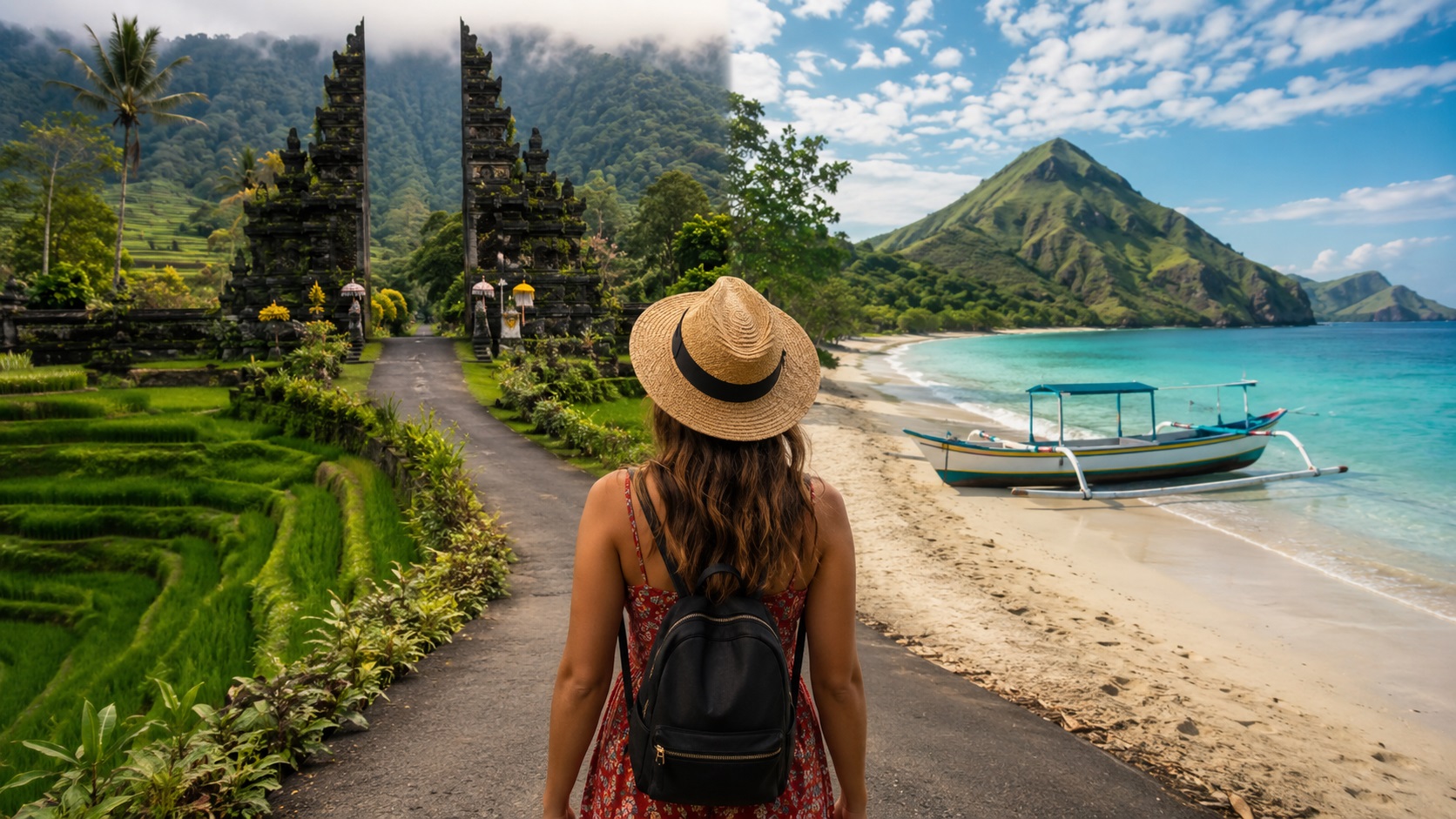
The Gili Islands: The Reason Most People Connect the Two
Between Bali and Lombok, a short boat ride from the northwestern coast of Lombok, sit three small islands: Gili Trawangan, Gili Meno, and Gili Air. No motorized vehicles. White sand. Clear water with good snorkeling directly off the beach. A party scene on Trawangan, a honeymoon scene on Meno, a middle-ground scene on Air. The Gilis are their own category — not really Bali, not really Lombok, but frequently visited as part of a trip that includes both. They're worth knowing about because they change the logic of the Bali-Lombok decision. Many people use the Gilis as a transition point: fast boat from Bali to the Gilis, two or three days, then continue to Lombok or return to Bali. This makes the geographic logic of the trip work efficiently and adds a beach stop that's genuinely different from the beaches on either main island. The downside of the Gilis is that Trawangan especially has become very touristy — the main drag is almost entirely bars, restaurants, and dive shops aimed at international visitors — and Meno has developed significantly. Air remains the most local-feeling. None of them are undiscovered, but Meno and Air are quiet enough that the setting still does most of the work.So Which Should You Visit First?
The direct answer depends on what kind of traveler you are. Go to Bali first if: You're visiting Indonesia for the first time and want a soft landing. Bali's tourist infrastructure makes it the easiest entry point in the country — the airport is well-connected, English is widely spoken, transport is organized, and the range of accommodation and food options means you can calibrate your trip easily once you're there. You're traveling with people who have different comfort levels with unpredictability. Bali can accommodate almost any preference, from backpacker to luxury, from full-immersion to poolside relaxation. Lombok demands more flexibility. You have limited time. A week in Bali is a more complete experience than a week in Lombok, simply because Bali has more variety within closer distances. You can do the cultural interior, the beaches, the surf, and the good food without the logistical overhead that Lombok requires. You're not particularly interested in hiking. If Rinjani isn't on your list, Lombok's main advantage over Bali is its beaches and quieter pace — both real benefits, but perhaps not worth prioritizing over Bali's convenience on a short trip. Go to Lombok first if: You've already been to Bali. This is the clearest reason. Bali on a second or third visit, when you already know what to expect, can feel like going somewhere you've already been. Lombok on a first visit feels like discovering something. If you're returning to Indonesia, go to Lombok first and use Bali as the familiar comfortable ending rather than the uncertain beginning. You're doing the Rinjani trek. Build your trip around the trek, spend a few days recovering on the south coast beaches, then finish in Bali. This is a logical route both geographically and in terms of physical demand — you want the hard thing first, not after two weeks of beach clubs. You specifically want less tourism infrastructure. If what you're looking for is genuinely quieter beaches, a slower pace, and the texture of a place that hasn't been fully optimized for visitors, start in Lombok. You'll appreciate Bali's convenience more after experiencing what its absence feels like. You're a confident traveler who finds heavy tourist infrastructure deflating. Bali's southern tourist strip is a specific kind of place that some travelers love and others find exhausting. If you know you're in the latter camp, Lombok first.The Honest Case for Doing Both
Most travelers to this part of Indonesia end up on both islands, and the logic is sound: they're close to each other, the fast boat between them takes under two hours, and they complement each other well enough that doing one without the other feels like leaving something unfinished. The natural sequence for most first-timers: fly into Bali, spend four or five days between the south and Ubud, take the fast boat to the Gilis for two or three nights, continue to Lombok for three or four days on the south coast beaches, fly home from Lombok (there are direct international connections, though fewer than Bali). That's a twelve to fourteen day itinerary that covers both islands at a reasonable pace without feeling rushed. It starts in the comfortable and known, moves toward the quieter and less traveled, and ends with beaches that will make you want to come back. If you only have a week, choose Bali. If you have two weeks, do both. If you've already been to Bali and are going back to Indonesia, Lombok is the answer before you've finished reading this sentence.A Few Practical Notes
Getting between the islands: Fast boats run multiple times daily between Padang Bai in eastern Bali and the Gilis, and between Bali and the Lombok port at Bangsal or Teluk Nare. Journey time is roughly two hours from Bali to the Gilis and slightly longer to Lombok directly. Book in advance during peak season — July, August, and the weeks around Christmas and New Year — as boats fill up. Perama, Eka Jaya, and Blue Water Express are the main operators. Flying vs. boating: Direct flights from Bali to Lombok take 30 minutes and can be cheap if booked in advance on Wings Air or Citilink. They make sense if you're going straight to Lombok without stopping at the Gilis, or if you're short on time. The boat is the better experience if you have a day to spend. When to go: The dry season, May through September, is the best time to visit both islands. October through April brings rain — not constant, but significant enough to affect beach days and make the Rinjani trek difficult. July and August are peak season with corresponding price increases and higher visitor numbers; June and September offer the same weather with fewer people.Trying to plan a Bali and Lombok itinerary for a specific trip length or starting point? Drop your details in the comments and I'll tell you how I'd structure it.


