
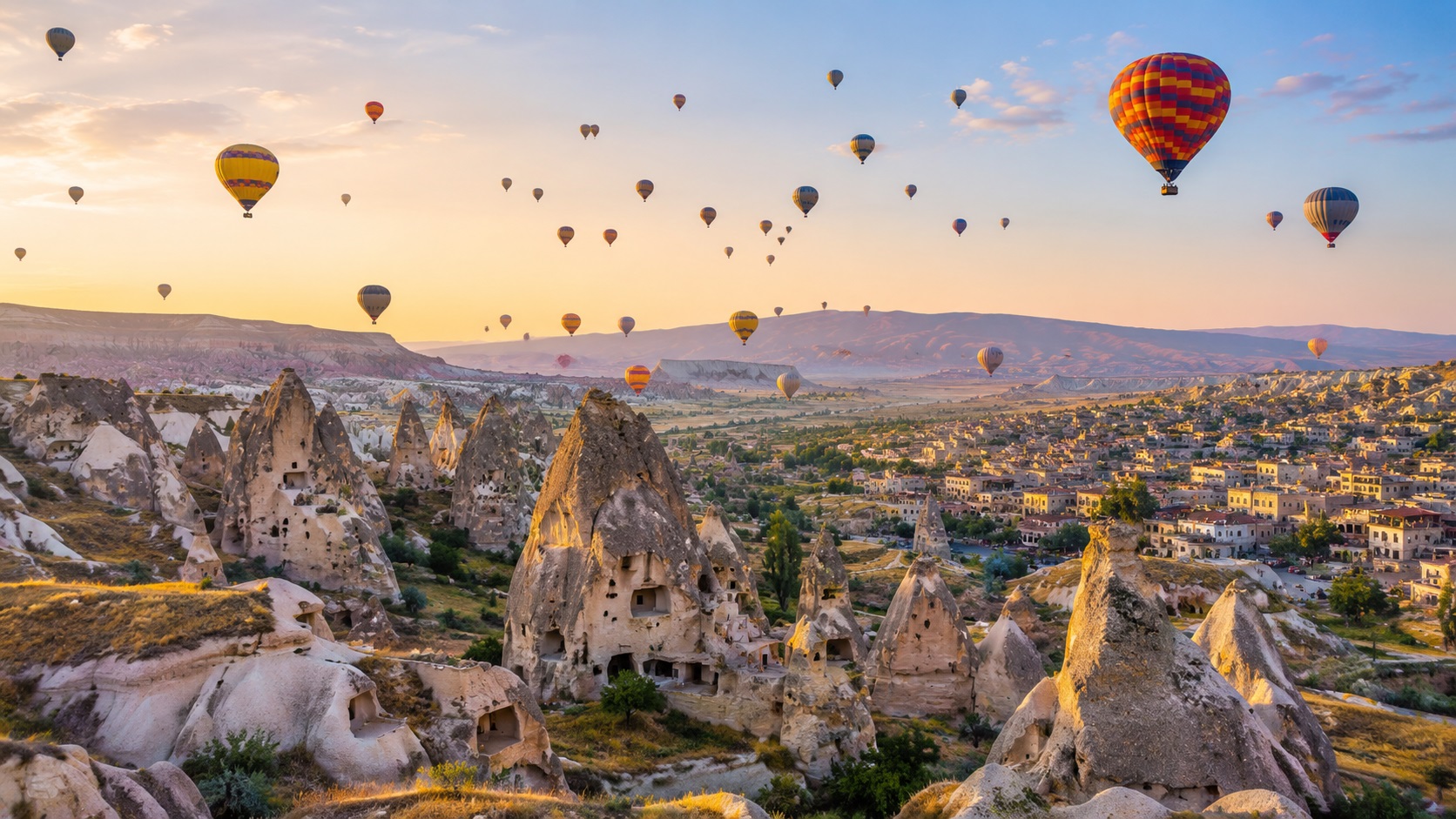
1. The Hot Air Balloon Is Worth It — But Book It Early and Manage Your Expectations
Let's get this out of the way first because it's the thing everyone asks about. Yes, a hot air balloon flight over Cappadocia at sunrise is a genuinely extraordinary experience. Floating above the valley as the light comes up and dozens of other balloons drift around you is the kind of thing that's hard to describe without sounding like a brochure. It earns its reputation. It also costs between $150 and $250 per person depending on the operator and season, lasts about an hour, and is not guaranteed to happen on any given day. Balloon flights are highly weather-dependent. Wind, rain, or poor visibility grounds the entire fleet, sometimes with only a few hours' notice. If your trip is short and you've booked for a specific morning, there's a real chance it won't fly. A few practical things: book directly with an established operator rather than through a hotel desk or tour agent, who will take a commission and sometimes pass you to a less reputable company. Butterfly Balloons and Royal Balloon are consistently well-reviewed. Arrive at your pickup point on time — the operation runs like clockwork and doesn't wait. Dress in layers; it's cold at altitude even in summer. If your flight gets canceled due to weather, most operators will offer a refund or a rebooking. Don't book non-refundable in case of cancellation.
2. Göreme Is the Base — But Not the Only Option
Most visitors stay in Göreme, the small town at the center of Cappadocia, and it makes sense as a base. It has the most accommodation options, the best access to the main hiking trails and valleys, and enough restaurants and cafes to keep you comfortable for several days. But Cappadocia is a region, not a single town, and some of the best accommodation is outside Göreme entirely. Ürgüp is a larger, slightly more upscale town with good restaurants and a more local feel. Uçhisar sits on a hill with sweeping views and is quieter than Göreme. Ortahisar has almost no tourists at all and some beautiful cave houses available to rent. If you have a car — which is worth considering — staying outside Göreme opens up the whole region rather than just the central valleys. Cave hotels deserve a specific mention. Staying in a room carved into volcanic rock is one of the things that makes Cappadocia genuinely different from other destinations, and the price range runs from budget guesthouses to extravagant boutique hotels with private terraces and plunge pools. Even at the mid-range, a cave room in Cappadocia is usually one of the more memorable places you'll sleep on a trip.3. Sunrise and Sunset Are the Only Times That Matter for Photography — and for the Experience in General
Cappadocia in the middle of the day, under flat overhead light, is fine. Cappadocia at golden hour, when the rock formations catch the low sun and turn amber and rose, is something else entirely. This is worth organizing your days around. The valleys — Rose Valley, Red Valley, Love Valley, Pigeon Valley — are best explored in the two hours before sunset, when the light is extraordinary and the temperature has dropped from its afternoon peak. Sunrise is better still, especially for the balloons, but requires either being a morning person or staying somewhere with a good east-facing view. The Uçhisar castle viewpoint at sunset is crowded but genuinely impressive. Rose Valley, accessed from the village of Çavuşin, offers a longer walk with constantly changing light and far fewer people than the main viewpoints. If you only have time for one evening hike, go to Rose Valley.4. You Need More Than Two Days
Two days is what most people plan. It's not enough. Cappadocia has underground cities, hiking trails through multiple valleys, open-air museums, ancient churches carved into cliff faces, pottery workshops in Avanos, viewpoints, and villages that most visitors never reach. A rushed two-day itinerary usually means hitting the main highlights at speed and leaving with the feeling that you saw it but didn't quite experience it. Three full days is the minimum to feel unhurried. Four or five days, particularly if you enjoy hiking or photography, is genuinely rewarding. The region rewards slow exploration — taking a different trail each morning, sitting at a viewpoint until the light changes, driving out to the lesser-visited villages in the afternoon. If you're constrained to two days, prioritize the balloon flight (one morning), a hiking trail at sunset (first evening), and the Göreme Open-Air Museum plus Derinkuyu Underground City (second day). That's an honest two-day itinerary, not a padded one.5. The Underground Cities Are Extraordinary and Exhausting
There are dozens of underground cities in Cappadocia, carved by early Christians who used them as hiding places during times of persecution. Two are open to tourists: Derinkuyu and Kaymaklı. Derinkuyu is the more impressive of the two — it goes eight levels deep, had ventilation shafts, wells, wine cellars, stables, and could shelter thousands of people for extended periods. Walking through it is genuinely mind-bending. It's also narrow, low-ceilinged, and involves a lot of crouching and single-file shuffling through stone tunnels. If you're claustrophobic, be honest with yourself before committing to the lower levels. The upper floors are manageable; the deeper you go, the more confined it gets. If you're traveling with young children, they often handle it better than adults — the tunnels were sized for historical inhabitants who were smaller than modern visitors. Go early in the morning to avoid the worst crowds. The sites get genuinely packed by mid-morning in high season, and navigating narrow underground tunnels while three tour groups are trying to pass each other is not a pleasant experience.6. Hiking the Valleys Is Free and Often Better Than the Paid Activities
This is the thing most visitors overlook because it doesn't appear on a tour itinerary. The valleys around Göreme — Rose Valley, Red Valley, Love Valley, Pigeon Valley, Sword Valley — are connected by hiking trails that anyone can walk for free. No guide required, no booking necessary, just a decent pair of shoes and a rough sense of direction. The trails vary from easy (Pigeon Valley, paved in sections, gentle gradient) to moderate (Rose to Red Valley circuit, some scrambling on loose rock). None of them require technical hiking ability. All of them pass through landscapes of fairy chimneys, ancient cave churches, carved dovecotes, and vineyards that are simply not visible from a road. Download the trails on Maps.me or AllTrails before you go — signal in the valleys is inconsistent. Take water, especially in summer when afternoon temperatures can exceed 35°C. And go late afternoon rather than midday: the light is better, the temperature is lower, and the valleys feel like they belong to you in a way they don't at peak hours.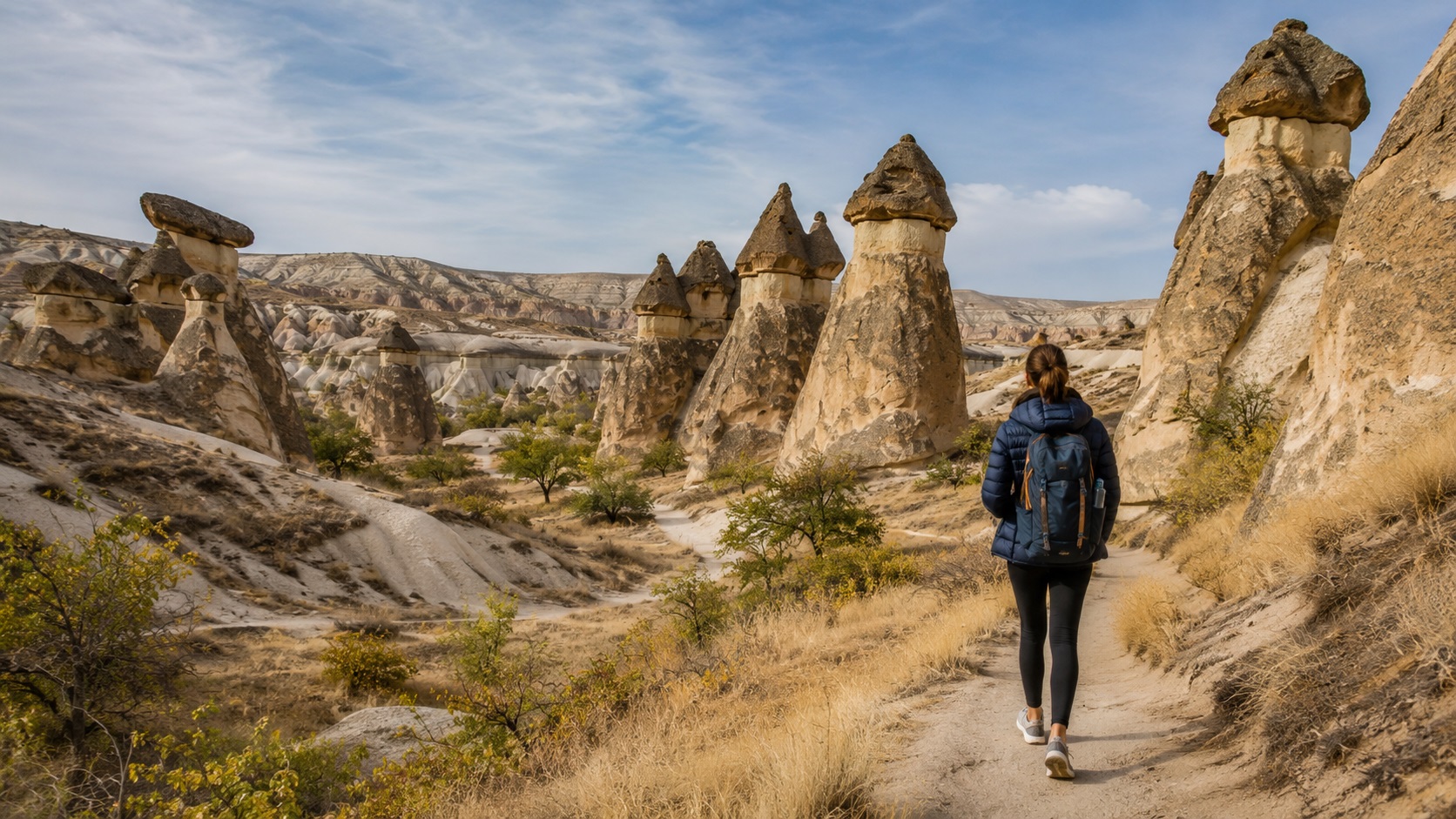
7. Turkish Food in Cappadocia Is Genuinely Good — If You Know Where to Look
The tourist restaurants around Göreme's main square are fine but rarely exciting. The regional food of Cappadocia — which sits in the heart of Anatolia — is worth making an effort for. Testi kebab is the dish most associated with the region: meat and vegetables slow-cooked in a sealed clay pot that's broken open at the table. It's a theatrical presentation and the food is genuinely good. Firın Sütlaç — baked rice pudding with a caramelized surface — is a dessert that appears everywhere and is almost always better than it sounds. For non-tourist food, walk a few streets back from the main square in Göreme and look for places where the menu is only in Turkish or has handwritten daily specials. Breakfast in Cappadocia — the standard Turkish spread of cheeses, olives, tomatoes, cucumbers, eggs, bread, and tea — is excellent and often included in your accommodation. Don't skip it. Avanos, the pottery town fifteen minutes from Göreme, has better food options than its reputation suggests and is worth a lunch stop when you visit the workshops.8. Getting Around Without a Tour Is Entirely Possible
Many people visit Cappadocia exclusively through guided tours, which is fine but limits your flexibility significantly. The main sights are accessible independently without much difficulty. Renting a car is the most liberating option. The roads are good, distances between sights are short, and having a car means you can stop wherever the light looks interesting, visit the less-touristed villages, and set your own schedule. An ATV or scooter rental is another option for confident riders, though the roads can be dusty and the terrain rough in places. The Cappadocia shuttle system — minibuses that run between towns — covers the main routes at low cost, though the schedules are loose and waiting times can be long. Walking and hiking between villages is underrated. Göreme to Çavuşin through Rose Valley, or Göreme to Uçhisar through Pigeon Valley, are both walkable in under two hours and far more interesting than taking a taxi. Guided tours make sense for the underground cities (where context genuinely helps) and for specific valley hikes if you're not comfortable navigating independently. For everything else, going independently is usually more rewarding.9. High Season Is Crowded in Ways That Can Genuinely Affect the Experience
June through August and the weeks around major holidays are peak season in Cappadocia. The balloon flights are fully booked weeks in advance, cave hotel rates double or triple, the Göreme Open-Air Museum has queues, and the main viewpoints at sunrise and sunset are crowded with other visitors and their phones. None of this makes Cappadocia not worth visiting in summer, but it changes how you need to plan. The best months are April, May, September, and October. The light is good, temperatures are pleasant for hiking (roughly 15–22°C during the day), and the crowds are significantly thinner. Spring brings some wildflowers to the valleys. Autumn sees the grape harvest, which adds activity to Avanos and the surrounding villages. Winter is an option that few people consider and some genuinely love. Snow on the fairy chimneys looks extraordinary. The region is quiet. Hotel prices are low. The main downside is that balloon flights are canceled more frequently due to weather, and some smaller hotels and restaurants close entirely in January and February.10. The Region Has a Depth That Most Visitors Don't Reach
Cappadocia's landscape was formed over millions of years by volcanic eruptions from Erciyes and Hasan mountains, which deposited thick layers of soft volcanic tuff that wind and water eroded into the formations you see today. The first people to carve into this rock did so thousands of years ago. The cave churches — many with Byzantine frescoes still visible — date from the 9th to 13th centuries. The underground cities were expanded and used through multiple historical periods. This context doesn't require a degree in art history to appreciate, but it does transform what you're looking at. A carved church in a cliff face is remarkable on its own. Understanding that it was painted by Byzantine monks who were hiding from persecution, using pigments made from local minerals, in a region that was once a major stop on early Christian pilgrimage routes — that changes what the visit means. The Göreme Open-Air Museum has decent information boards, but the best context comes from a few hours of reading before you arrive. The Dark Church (Karanlık Kilise), with its exceptionally well-preserved frescoes, is worth the small additional entry fee and is more moving when you know something about what you're looking at. Cappadocia rewards curiosity. The visitors who leave having seen something profound rather than just something photogenic are usually the ones who arrived with a few questions already in mind.Visiting Cappadocia soon? Drop your questions in the comments — happy to help with specific itineraries, hotel recommendations, or anything else.


