
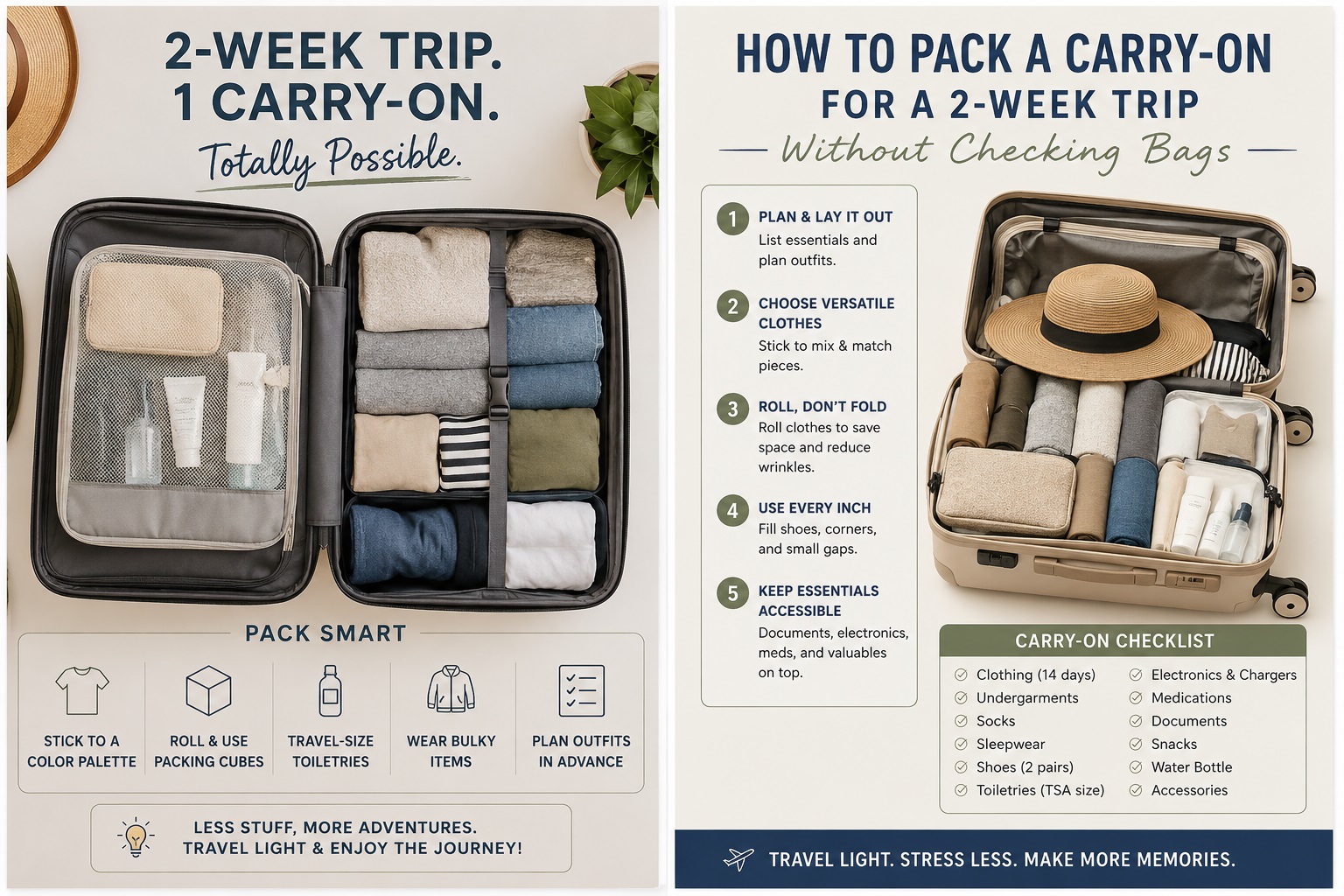
How to Pack a Carry-On for a 2-Week Trip Without Checking Bags
The first time I did a two-week trip with only a carry-on, I was convinced I’d run out of clothes by day five and spend the second week in a mild panic. That didn’t happen. What happened instead was that I got through airports faster, never waited at a baggage carousel, saved money on checked bag fees, and didn’t once have to worry about my luggage ending up in the wrong city.
I’ve checked a bag exactly twice since then, both times because I was carrying something that couldn’t go in the cabin. Everything else — two weeks in Japan, ten days road-tripping through Portugal, two weeks island-hopping in Greece — fit in a carry-on and a small personal item.
This isn’t about packing light as an ideology. It’s about knowing what you actually need versus what you think you’ll need, and recognizing that those two lists are almost never the same.
Start With the Right Bag
Before anything goes inside it, the bag itself matters.
Most airlines allow a carry-on of roughly 55 x 40 x 20 cm (22 x 16 x 8 inches) and a personal item — a backpack or tote that fits under the seat in front of you. Budget airlines (Ryanair, Wizz Air, easyJet) have stricter rules and often charge for larger cabin bags, so check the specific airline’s policy before you buy a bag around it.
Two formats work well for carry-on travel:
A hard-shell spinner suitcase in the 20–22 inch range is easy to pack, protects your things, and rolls smoothly through airports. The downside is that it’s rigid — you can’t compress it to fit an overhead bin that’s already crowded, and it’s awkward on cobblestones or uneven surfaces.
A travel backpack (40–46 liters is the sweet spot) is more versatile. It goes on your back, handles any terrain, and a well-designed one with a clamshell opening packs just as neatly as a suitcase. Brands like Osprey, Tortuga, and Nomatic make bags specifically designed to hit airline size limits while maximizing usable space.
Neither format is objectively better. Choose based on the kind of trip you’re taking and how much walking between destinations you expect to do.
The Clothing Calculation
This is where most people go wrong. They think in terms of outfits rather than pieces, and they plan for the best possible scenario rather than the realistic one.
Here’s the honest math for a two-week trip:
Tops: 4–5 You do not need fourteen tops. A solid rotation of four or five shirts or blouses — mix of casual and slightly smarter — is enough. If you’re somewhere with laundry access (most hotels, hostels, and Airbnbs), you can wash and dry within 24 hours. If you’re not near laundry, handwashing a top in a sink and hanging it overnight works for most fabrics.
Choose colors that work together. Three neutrals and two colors that complement them means everything you packed goes with everything else, which means you actually wear it all.
Bottoms: 2–3 Two pairs of pants or two pants plus a skirt or shorts. Bottoms are the easiest category to under-pack because they don’t need washing as frequently as tops, and they take up the most space. A well-chosen pair of dark jeans goes from casual sightseeing to a nice dinner without changing. Trousers in a wrinkle-resistant fabric pull double duty in even more contexts.
Underwear: 5–7 pairs Five is the floor. Seven gives you flexibility. Merino wool or quick-dry synthetic underwear can be handwashed and dried overnight, which means even five pairs is technically enough for two weeks with a mid-trip wash.
Socks: 4–5 pairs Same principle. Merino wool socks are worth the price for travel specifically — they regulate temperature, resist odor, and dry quickly. Pack fewer pairs than you think you need and you’ll probably be fine.
One layer for warmth A packable down jacket, a light fleece, or a structured cardigan depending on the climate. This takes up more space than anything else in the bag, so choose carefully. A packable puffer compresses to roughly the size of a water bottle and covers you in most cool-weather situations.
One dressier option If your trip involves anything that requires being slightly more put together — a nicer restaurant, a work meeting, a wedding — pack one item that elevates your look. For most people this is a blazer, a dress, or a button-front shirt. Not a separate outfit. One item.
Shoes: 2 pairs maximum, worn on the plane Shoes are the single most space-consuming category and the one most people over-pack. Two pairs: one comfortable walking shoe that you can wear all day, and one shoe that works for smarter occasions. Wear the bulkier pair on travel days so neither takes up bag space. If you’re going somewhere where specific footwear is genuinely necessary — hiking boots for a trekking trip, for example — those become your walking shoe and you adjust accordingly.
Fabrics Make or Break This
The clothes that work for carry-on travel are not necessarily the same ones you wear at home.
Merino wool is the gold standard for travel clothing and is worth knowing about if you don’t already. It’s naturally odor-resistant (you can wear the same merino shirt multiple days before it needs washing), temperature-regulating, wrinkle-resistant, and it dries quickly. It’s expensive upfront but reduces how much you need to pack significantly. Icebreaker, Smartwool, and Unbound Merino make good options across different price points.
Synthetic quick-dry fabrics — nylon, polyester blends — are cheaper than merino and dry faster, but they tend to hold odor more than wool. Fine for active travel or beach trips, less ideal for city travel where you’re wearing the same shirt to dinner.
Cotton is the worst fabric for travel. It takes forever to dry, wrinkles badly, and holds moisture. If you’re handwashing a cotton shirt in a hostel sink, it might still be damp the next morning. Leave your cotton pieces at home where they belong.
Linen is a middle ground — great for warm climates, dries faster than cotton, but wrinkles extremely easily. Worth it for beach or Mediterranean trips if you can tolerate the creases.
Toiletries: The 100ml Reality
On flights, liquids in your carry-on must be in containers of 100ml or less, all fitting in a single 1-litre clear zip-lock bag. This sounds more limiting than it is in practice.
What to bring:
A small bottle of shampoo and conditioner — or a shampoo bar, which has no liquid restrictions and lasts longer. Solid toiletry bars (shampoo, conditioner, body wash combined) have gotten genuinely good in the last few years and are worth trying before your trip.
Toothpaste in a travel tube. Toothbrush. Deodorant — solid stick rather than spray or roll-on.
Sunscreen is the one toiletry that causes genuine size problems because you often need more than 100ml over two weeks in a sunny climate. Options: buy a full-size tube at your destination, ship one ahead if you’re renting an apartment, or pack a 100ml tube and buy more locally. Most places in Europe and Southeast Asia have sunscreen that works fine.
What not to bring:
Full-size anything. Hair dryer (hotels have them; pack a small attachment if you use a diffuser). More than one backup of anything. Products you use “occasionally” — you won’t use them on a trip either.
A clear toiletry bag that opens fully flat is worth buying if you don’t have one. Being able to lay it out and see everything makes the airport security process faster and prevents you from forgetting things at the bottom.
The Personal Item: Use It Strategically
Your personal item — the bag that goes under the seat — is not just overflow from your carry-on. It’s a second category entirely.
This is where your travel day essentials live: laptop or tablet, headphones, chargers, passport and documents, a book or e-reader, snacks, a water bottle you’ll fill after security, and anything you might want mid-flight.
A well-organized personal item also serves as your day bag at the destination. If you’re spending a day sightseeing, you leave your carry-on at the accommodation and take just the personal item. Pack accordingly — it should function as a standalone daypack, not just an airport bag.
A 20–25 liter backpack works well for this. Anything larger starts to encroach on the overhead bin space other passengers need.
How to Find Cheap Flights: 9 Tricks That Actually Work
Packing Cubes: Worth It or Not?
Worth it, with caveats.
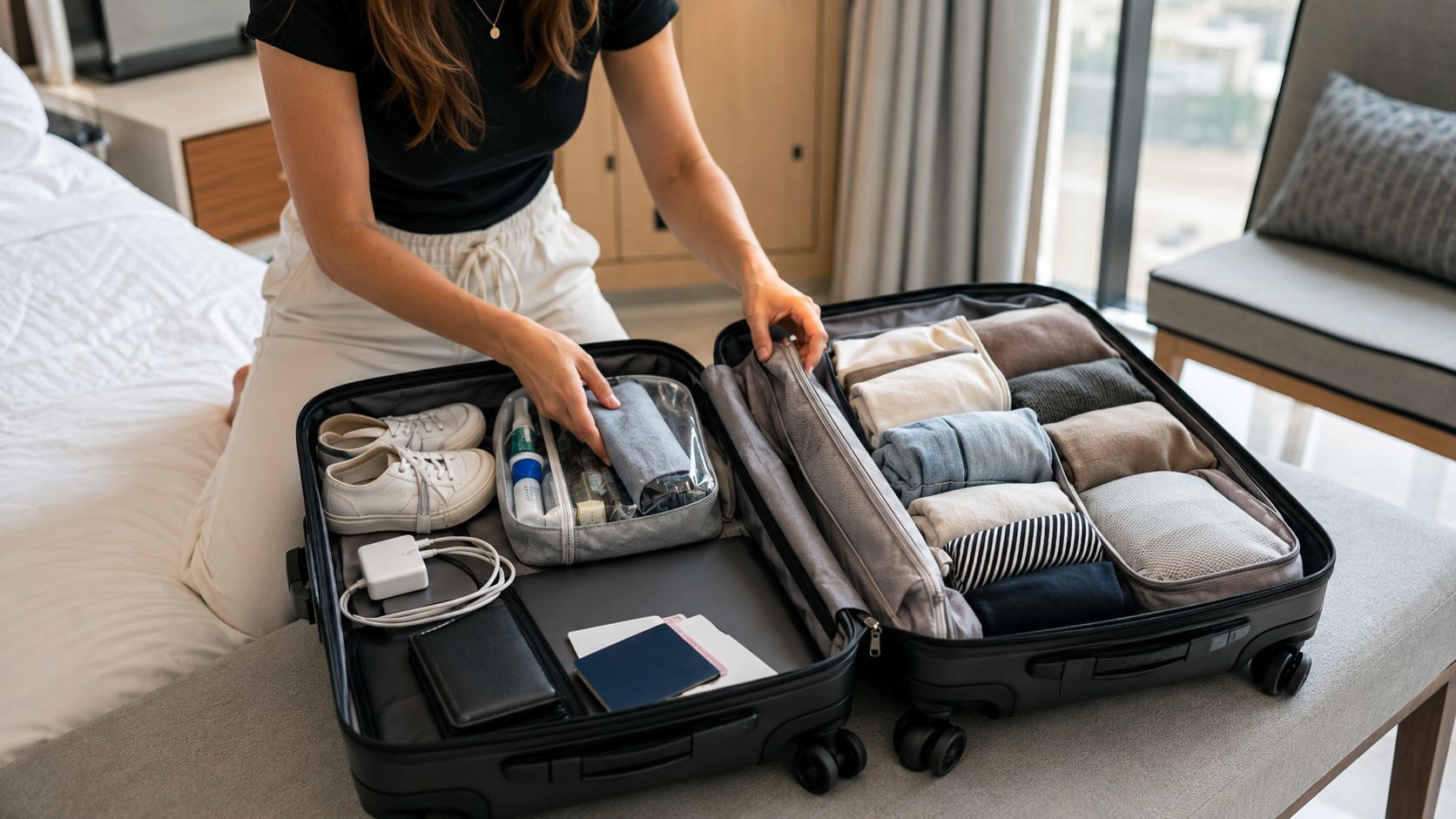
Packing cubes compress your clothes into organized blocks, which makes the most of a carry-on’s rectangular space and makes finding things easier. They’re not magic — they don’t create space that doesn’t exist — but they keep things organized and prevent the entropy that usually sets in by day four of a trip when everything has been removed and repacked multiple times.
One cube for tops, one for bottoms, one for underwear and socks, one for anything that might leak (toiletries go here as a second layer of protection). A compression cube — one with a second zip that compresses the contents — is useful for the layer you wear least often.
Don’t buy eight cubes for a carry-on. Three or four is enough.
Electronics and Cables
Pack what you actually use, not what you might use.
Laptop if you need it. Tablet or e-reader is lighter and covers most on-the-road needs. Phone charger. One universal adapter (not several — one). Portable battery pack. Earphones or headphones.
A small cable organizer — a roll-up pouch or a flat case with elastic loops — is genuinely useful and costs almost nothing. Loose cables in a bag find each other and knot together without fail.
A Sample Packing List for Two Weeks
To make this concrete:
Clothing
- 5 tops (3 neutral, 2 with color — all merino or quick-dry)
- 2 pairs of trousers (one casual, one slightly smarter)
- 1 pair of shorts or a skirt depending on the destination
- 1 packable down jacket
- 1 blazer or cardigan (doubles as layer and dressy option)
- 5 pairs of underwear (merino or quick-dry)
- 4 pairs of socks (merino)
- 2 pairs of shoes (worn on travel days)
Toiletries
- Shampoo bar or 100ml bottle
- Conditioner bar or 100ml bottle
- 100ml body wash or soap bar
- Toothbrush and travel-size toothpaste
- Solid deodorant
- 100ml sunscreen + buy more at destination
- Lip balm, moisturizer, any medications
Electronics
- Phone and charger
- Laptop or tablet
- Universal adapter
- Portable battery pack
- Earphones
Documents and other
- Passport, travel insurance documents, copies stored in email
- Debit and credit cards
- Small amount of local currency for arrival
- Pen (for customs forms)
The Things People Regret Packing
Just as useful as knowing what to bring: knowing what consistently comes home unworn.
The “just in case” outfit that covers a scenario that never materializes. The novel that stays in the bag because you end up reading on your phone. The full-size shampoo because you weren’t sure if there’d be any at the hotel (there is always shampoo at hotels). The extra pair of shoes you wore once. The hairdryer. The backup charger for a device you didn’t bring.
Every item in your bag has a weight and a space cost. The question to ask for each one isn’t “might I need this?” — it’s “what specifically would I do without this, and is that outcome worse than carrying it for two weeks?”
Most of the time, the answer is that you’d manage fine.
The Night Before: The Final Edit
Pack everything you intend to bring. Then look at the bag.
If it closes easily and isn’t straining at the seams, you’re done.
If it’s tight, remove the two or three things you’re least certain about. Not the things you packed last — the things you’re least sure you’ll actually use. Put them on the bed. Go to sleep. In the morning, if you don’t immediately think “I need that,” leave it behind.
You will not miss it. You never do.
Packing for a specific destination or climate? Leave a comment with the details and I’ll help you work out what to bring.




One Comment