The Right Way to Exchange Currency Before You Travel
Currency exchange is one of those travel topics where the difference between doing it well and doing it badly is measured in real money — sometimes a lot of it. A two-week trip to Southeast Asia where you exchange your cash at airport kiosks instead of using an ATM with the right card could cost you $80–120 in unnecessary fees and poor exchange rates. Multiply that across a few trips and it’s a flight.
The annoying thing is that the right approach isn’t complicated. It’s just not instinctive, because the most convenient options — the airport exchange desk, the hotel currency counter, the currency exchange booth in the tourist district — are almost always the worst value. They exist because travelers need currency and are in a vulnerable position (just arrived, don’t know the local system yet, pressed for time), and they price accordingly.
This is what you actually need to know.

The Exchange Rate Is the Thing That Matters Most
Before getting into specific approaches, it helps to understand what you’re actually comparing when you look at different currency exchange options.
The interbank exchange rate — sometimes called the mid-market rate or the “real” exchange rate — is the rate at which banks exchange currency with each other. It’s the rate that appears when you search “USD to EUR” on Google. It’s also the rate that no retail currency exchange will give you, because the margin between the interbank rate and the rate they offer to customers is how they make money.
Every currency exchange option you’ll encounter as a traveler adds a spread on top of the interbank rate. The question is how large that spread is. A spread of 0.5–1% is excellent. A spread of 3–5% is average. A spread of 8–12% — which is common at airport kiosks and hotel currency desks — is expensive.
The practical test: before any trip, search the interbank rate for your currency pair and write down the number. When you compare exchange options, calculate what percentage above that rate you’re being offered. That percentage, plus any flat fees, is the actual cost of the transaction.
What Doesn’t Work (And Why You Should Ignore It)
Let’s clear away the bad options first, because these are what most first-time international travelers end up using.
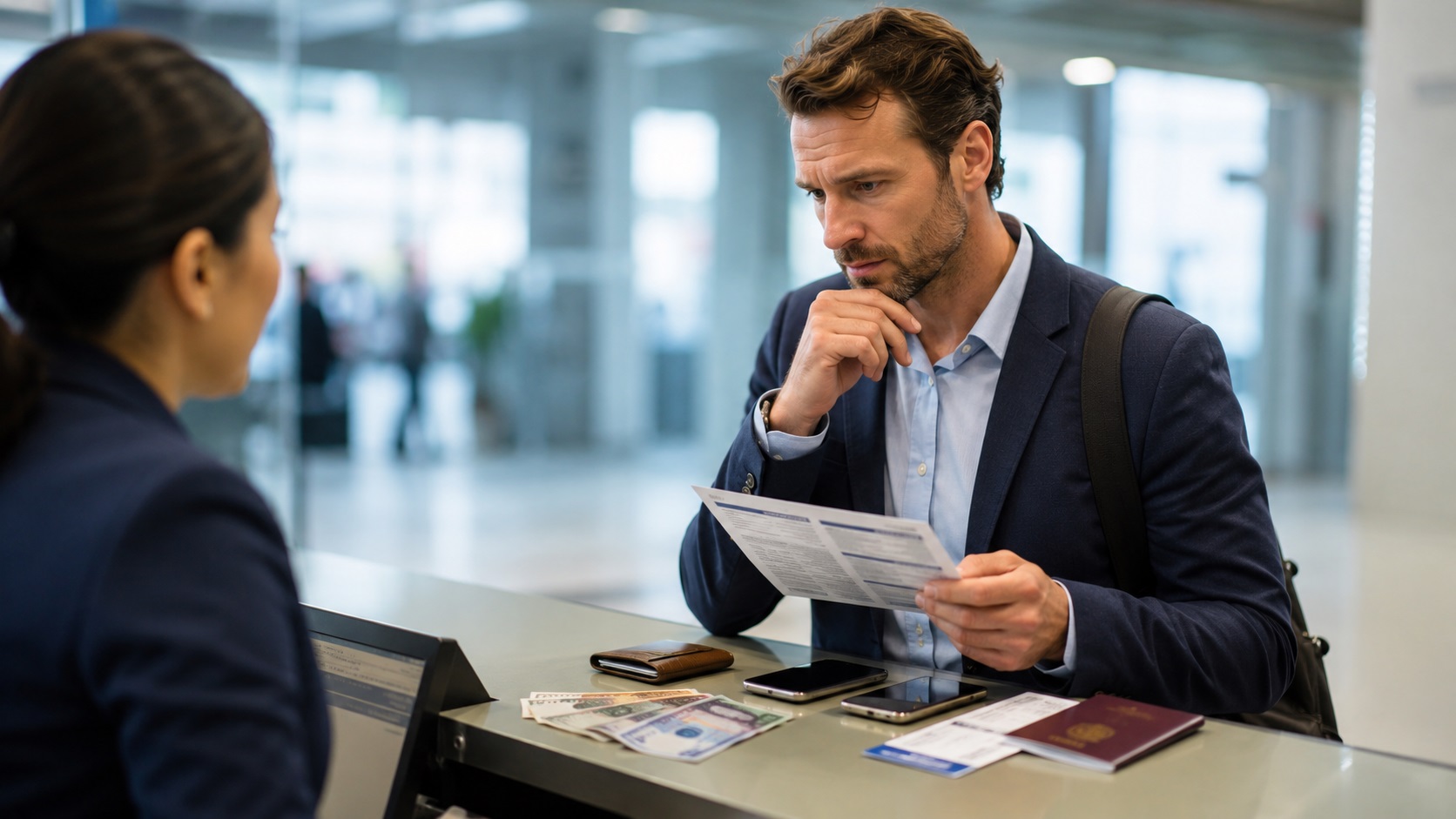
Airport currency exchange desks are the worst option available in most countries. They combine poor exchange rates (often 8–12% above the interbank rate), sometimes a flat transaction fee on top, and occasionally a deliberately confusing display that makes it hard to quickly calculate what you’re actually getting. The convenience is real — you’ve just arrived, you need cash, there’s a desk right there — but the cost is significant. The only justification for using one is getting just enough cash to cover your taxi from the airport if you have no other option, then finding a better solution once you’re in the city.
Hotel currency exchange is similarly poor value for similar reasons. Hotels that offer currency exchange are offering it as a convenience service with a comfortable margin built in. The rate will almost never be competitive.
Currency exchange booths in tourist areas vary more than the airport and hotel options. Some offer reasonable rates; many don’t. The “no commission” signs that appear outside many exchange booths are almost always misleading — the commission is built into the exchange rate rather than charged separately. Always ask for the exact amount you’ll receive for a specific sum before handing over any money, and compare the implied rate to the interbank rate on your phone.
Traveler’s checks are effectively obsolete. They’re difficult to use, widely not accepted, and offer no meaningful advantage over the alternatives available today. Skip them entirely.
What Actually Works
Using a debit card at a local ATM is the most consistently reliable way to get local currency at a good rate in most countries. The ATM draws directly from your home account, converts at or near the interbank rate (depending on your bank), and charges whatever fee your bank applies.
The critical variables are:
Your bank’s foreign transaction fee. Many standard bank accounts charge 2–3% on foreign currency transactions plus a flat ATM fee of $3–5. On a $200 withdrawal, this adds up. Some accounts — particularly those designed for travelers — charge no foreign transaction fee and reimburse ATM fees worldwide. If you travel more than once a year, having one of these accounts is worth looking into.
The ATM’s own fee. Many international ATMs, particularly in tourist areas, charge a fee for foreign card use on top of whatever your bank charges. This is usually disclosed before you confirm the transaction and is worth checking. ATMs associated with major local banks tend to charge less than standalone machines in tourist areas.
The “dynamic currency conversion” trap. This is important enough to describe in detail. When you use a foreign ATM, you’ll sometimes be asked whether you want to complete the transaction “in your home currency” or “in the local currency.” Always choose the local currency. Choosing your home currency — which sounds convenient — means the ATM converts the currency at its own rate, which is invariably worse than the rate your bank would apply. This is called dynamic currency conversion and it’s a hidden fee dressed up as a service.
The same DCC warning applies to card payments at restaurants, shops, and hotels when the card terminal asks whether you want to pay in your home currency or the local currency. Always choose local currency.
No-fee international debit cards are the cleanest solution for ATM withdrawals abroad. Accounts like Charles Schwab High Yield Investor Checking (US), Wise (available in multiple countries), Starling Bank (UK), and similar products are specifically designed for international use — they offer interbank exchange rates or very close to it, charge no foreign transaction fees, and in some cases reimburse ATM fees. Opening one before an international trip is a one-time setup that pays for itself quickly.
The Case for Carrying Some Cash
Despite the ATM approach being generally the best option, there are specific situations where having local currency in cash before you arrive genuinely matters.
Countries with limited ATM availability. In rural areas, smaller towns, and some developing countries, ATMs may be scarce, unreliable, or limited in how much they dispense per transaction. Arriving with some local currency avoids being caught without cash when the ATM in the small town you’re staying in is out of service.
Countries with restricted currencies. Some currencies can’t be purchased outside the country or are very difficult to find abroad — the Moroccan dirham, the Indian rupee, the Vietnamese dong. For these destinations, you’ll need to exchange on arrival (using an airport ATM or a local bank, not the airport exchange desk), so arriving with a small amount of USD or EUR as a bridge is useful.
The airport transfer problem. If your ATM card doesn’t work on arrival for any reason — card blocked by your bank, ATM temporarily down, network issue — having no local currency at all leaves you with no options for getting from the airport to your accommodation. Carrying $50–100 in USD (which is accepted in many countries) or exchanging a small amount before departure provides a backup.
Tipping economies. In countries where cash tipping is standard — the US, much of Latin America, some parts of Asia — having local cash available at all times matters practically. Relying entirely on card payments in a tipping-heavy environment is workable but creates friction.
The Wise Card: Worth Knowing About
Wise (formerly TransferWise) has become one of the most useful products for international travelers and is worth understanding as a separate category.
Wise is a financial technology company that offers both a money transfer service and a debit card. The Wise card holds balances in multiple currencies and converts between them at the interbank rate with a small transparent fee (typically 0.35–2% depending on currency pair). You can hold money in dozens of currencies simultaneously, spend from the relevant currency balance when traveling, and convert at the real exchange rate rather than a bank’s marked-up rate.
For travelers who move between multiple countries on a single trip, the Wise card is particularly useful — you can load it with the local currencies of each destination before you leave, or let it auto-convert from your base currency as needed, in both cases at rates significantly better than what a standard bank card offers.
The limitations: Wise ATM withdrawals are free up to a monthly threshold, then a fee applies. It’s not a bank account in the traditional sense and doesn’t have the same protections as a regulated bank in all jurisdictions. But for the specific purpose of spending money in foreign currencies at low cost, it’s one of the best tools available.
Ordering Currency Before You Leave: When It Makes Sense
Ordering foreign currency from your home bank before departure is sometimes presented as the responsible, organized approach. The reality is more nuanced.
Home bank currency ordering is convenient — your local branch or online ordering system delivers cash in the currency you need — but the rates are typically in the same range as a mid-quality airport exchange: 3–6% above the interbank rate. Not as bad as an airport kiosk, but not as good as an ATM with a good card.
The times when pre-ordering currency makes sense:
You’re traveling somewhere where ATMs are genuinely unreliable or limited, and you want the certainty of arriving with cash.
You need a small amount of a minor currency that might be hard to find abroad — some currencies are better obtained at home than in the destination country.
The currency you need is heavily restricted internationally and unavailable through ATMs at your destination.
For most popular international destinations with reliable banking infrastructure — Western Europe, Japan, Southeast Asia, Latin America — pre-ordering currency at home offers no meaningful advantage over simply using an ATM on arrival and paying a worse rate for the privilege.
Specific Country Notes
Currency exchange works differently in different parts of the world, and a few country-specific notes are worth having.
United States: If you’re arriving from abroad, US ATMs are universally available, reliable, and serve virtually every currency. The US dollar is also accepted in many countries as a parallel currency, making it worth carrying a small amount even when the local currency is your primary.
Japan: Japan remains substantially cash-based compared to most developed economies. Many smaller restaurants, temples, and shops don’t accept cards. ATMs at 7-Eleven and Japan Post (easily found everywhere) reliably accept foreign cards and are the standard recommendation for withdrawing yen.
Turkey: The Turkish lira has been volatile in recent years. Exchange rates at Turkish banks and ATMs are generally better than exchanging abroad. Currency exchange bureaus (döviz bürosu) in Istanbul are competitive and worth using for cash-to-lira exchanges if you’re carrying USD or EUR.
Southeast Asia: ATM availability is excellent in cities throughout Thailand, Vietnam, Malaysia, and Indonesia. ATM fees charged by local banks have increased in recent years — Thailand in particular has moved to a standard fee of around 220 baht per foreign withdrawal. Withdrawing larger amounts less frequently reduces the fee impact.
Morocco: The dirham is a restricted currency, meaning you can’t buy it outside Morocco and you can’t take more than a small amount out when you leave. Exchange at the airport on arrival (using a bank counter rather than the exchange kiosk if possible), or use ATMs in Casablanca, Marrakech, or Fes. Keep receipts if you want to convert remaining dirhams back on departure.
The Simple Pre-Trip Checklist
Before any international trip, run through this:
Check whether your debit card charges foreign transaction fees. If it does, consider opening a no-fee travel account before departure.
Notify your bank of your travel dates and destination. Most banks allow this through their app and it prevents your card being blocked for suspected fraud when you use it abroad.
Research ATM availability at your destination. In most countries this takes thirty seconds of searching; in less common destinations it’s worth more thorough research.
Carry a small amount of USD or EUR as a backup. Not for primary spending — for the scenario where your card doesn’t work on arrival.
Set your phone to show the interbank rate for your currency pair. This takes five seconds and gives you a reference point to evaluate every exchange option you encounter.
Know the DCC rule: always pay in local currency, never your home currency, when given the choice at an ATM or card terminal.
That’s the whole system. None of it requires a financial background or significant preparation time. The people who consistently get good currency exchange rates when traveling are not people with special knowledge — they’re people who made three or four decisions before they left and then didn’t have to think about it again.
Disclaimer: Exchange rates, fees, and card terms change frequently. Always verify current rates and conditions directly with your bank or card provider before traveling.
Heading somewhere with an unusual currency situation or not sure whether your current bank card is right for travel? Leave the details in the comments and I’ll tell you what I’d do.