
Inventory: Where Each Platform Is Strongest
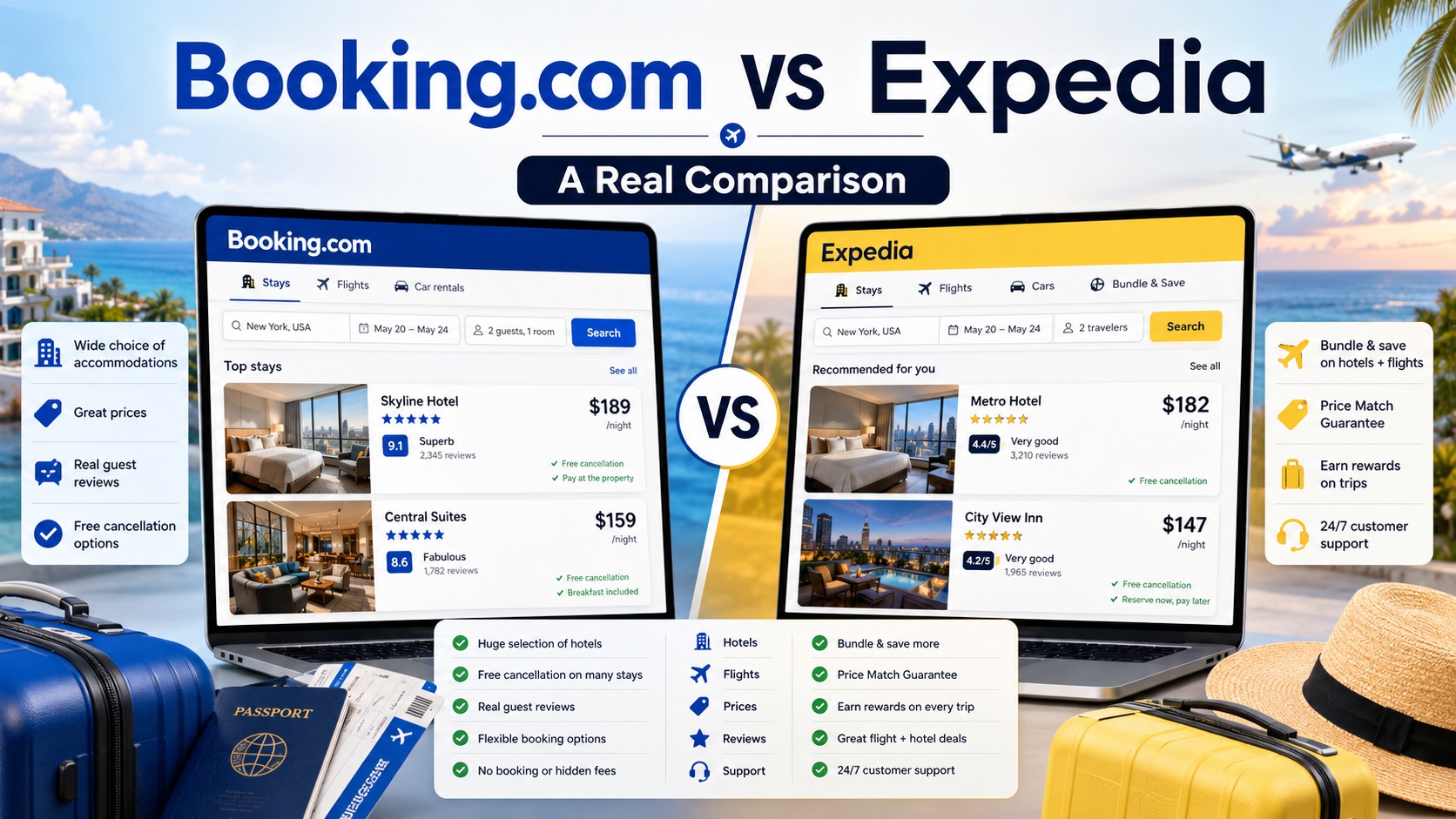
The most fundamental difference between Booking.com and Expedia is geographic coverage and property mix. Booking.com has a significantly larger global inventory, particularly in Europe and Asia. The platform started as a European company and its hotel database in countries like France, Spain, Italy, Germany, and the Netherlands is deeper than Expedia's — more properties, more independent hotels and guesthouses that don't appear elsewhere, and more boutique options that a larger platform might not bother with. In most European cities, Booking.com will show you ten to twenty percent more options than Expedia for the same search. For independent travel in Europe, Southeast Asia, or the Middle East, Booking.com is almost always the more useful starting point simply because the inventory is richer. Expedia is stronger in North America. American hotel chains, resort properties, and domestic US and Canadian travel are all better represented on Expedia than on Booking.com, partly because Expedia is a US-headquartered company with deeper relationships in that market. If you're booking a domestic trip within the United States — a resort in Florida, a ski lodge in Colorado, a business hotel in Chicago — Expedia's inventory is at least comparable to Booking.com and sometimes better. Expedia also has an advantage that Booking.com doesn't: it's a full travel platform. Booking flights, hotels, and car rentals through Expedia in a single transaction is possible in a way it isn't on Booking.com, which focuses primarily on accommodation. This matters in specific circumstances — more on that below.Pricing: The Comparison That Requires Actual Work
The pricing comparison between Booking.com and Expedia is the one most people want and the one that's hardest to give a clean answer to, because it varies by property, by date, and by how much flexibility you have. Both platforms claim to offer the best prices. Neither claim is reliably true across the board. What is reliably true is that prices for the same room at the same hotel on the same dates are often different between the two platforms — sometimes significantly. In my experience, Booking.com is cheaper more often than Expedia, but Expedia is cheaper often enough that checking both is worth the two minutes it takes. The practical habit that produces the best results: use Google Hotels first. It aggregates prices from Booking.com, Expedia, Hotels.com, and other platforms simultaneously, showing you where the room is cheapest before you commit to either platform. This eliminates the need to manually check multiple sites and consistently surfaces price differences you'd miss by going directly to one platform. One pricing nuance worth understanding: Expedia's One Key loyalty program gives members access to slightly reduced rates and accumulates "OneKeyCash" on bookings that can be used on future trips. If you book through Expedia regularly, the loyalty value is real. Booking.com's Genius loyalty program similarly offers discounts at participating properties — typically 10–15% off — for members who have completed a threshold number of bookings. Both programs are free to join and worth using if you're booking through either platform consistently.Cancellation Policies: Where the Platforms Genuinely Differ
This is the area where the difference between Booking.com and Expedia matters most in practice, and it's the one most travelers overlook until something goes wrong. Booking.com generally displays each property's individual cancellation policy clearly before you confirm a booking, and the range of options — from fully refundable to non-refundable — is visible upfront. Many properties on Booking.com offer free cancellation until close to the arrival date, and filtering specifically for free cancellation options is straightforward. This makes Booking.com the better platform for travelers who value flexibility. Expedia has a more complicated cancellation landscape. Package bookings — flights plus hotel combined — are often non-refundable or have more restrictive refund terms than standalone hotel bookings, and the policies can be harder to read clearly before committing. Individual hotel bookings on Expedia generally follow the property's own cancellation policy, similar to Booking.com, but the interface makes it slightly less obvious. The practical lesson: read the cancellation policy before booking on either platform, not after. The difference between a refundable and a non-refundable booking is not always obvious at the price comparison stage, and non-refundable bookings are only good value if you're certain you're going.Customer Service: The Honest Assessment
Both platforms have customer service reputations that range from fine to genuinely frustrating depending on the situation. Neither should be your primary strategy for resolving problems — that conversation should be with the property itself, which has more incentive and more ability to fix things than a platform's call center does. Booking.com's customer service is reachable by phone and through in-app messaging. In straightforward situations — a property that doesn't match the description, a booking that wasn't honored — they're usually responsive and will typically offer a refund or alternative accommodation. In complex situations involving disputed charges or cancellation disagreements between the platform and a property, the response is more variable. Expedia's customer service has a worse reputation overall, particularly for package bookings when something goes wrong with one element of a trip. A flight cancellation that affects a hotel booking, or a hotel issue that affects a connecting flight, involves Expedia as an intermediary between you and two separate providers — and the coordination required often falls on the traveler rather than the platform. The practical implication: for standalone hotel bookings, customer service quality between the two is roughly comparable. For package bookings, Expedia's more complex structure creates more potential failure points. If something can go wrong with a package booking, it usually goes wrong at the seams between the components.The Expedia Package Deal: When It's Actually Worth It
The one area where Expedia has a genuine advantage over Booking.com is the flight-plus-hotel package, and it's worth understanding when this actually saves money rather than just appearing to. Expedia bundles flights and hotels in a way that sometimes produces total prices below what the components would cost separately. The saving comes from the airline or hotel offering a discounted rate specifically for package sales — rates that don't appear if you search for them individually. These deals are real and occasionally significant. The catch: the package price hides the individual costs of each component. You know the total but not how much of it is the flight and how much is the hotel. This makes it impossible to comparison-shop the individual pieces, and it means the "savings" may not be as large as they appear when you can't verify what the hotel alone would have cost. Packages also tend to have more restrictive cancellation terms, as mentioned above. The discount for combining comes with reduced flexibility. When packages are worth considering: when you're booking a leisure trip with fixed dates, to a destination where you haven't found a meaningfully better hotel deal independently, and where you're confident you won't need to cancel. When they're not: when you have flexibility on dates or accommodation choice, when you've already found a strong hotel deal elsewhere, or when you're traveling somewhere that your cancellation needs are unpredictable.Booking.com's Genius Program vs. Expedia's One Key
Both platforms have loyalty programs that offer real value to frequent users. They work differently and reward different patterns of use. Booking.com Genius has three tiers based on completed bookings: Genius Level 1 (5+ bookings), Genius Level 2 (15+ bookings), and Genius Level 3 (30+ bookings). Higher tiers unlock larger discounts — typically 10–15% at Level 1, up to 20% at higher levels — at participating properties. Not every property participates, but enough do that the discount is consistently findable. The program also includes free breakfast and room upgrades at some participating hotels, which have genuine value. Genius works well if Booking.com is your primary booking platform and you make enough annual bookings to maintain tier status. The discounts are automatic and clearly labeled; you don't need to do anything to apply them once you're a member. Expedia One Key is a newer program that merged the loyalty schemes of Expedia, Hotels.com, and VRBO into a single system. You earn "OneKeyCash" on eligible bookings — roughly 2% of the booking value — which can be applied to future bookings on any of the three platforms. If you use all three (Expedia for hotels, VRBO for vacation rentals, and book flights through Expedia), the combined earning makes the program more valuable. If you only use one platform occasionally, the rewards accumulate slowly. Neither program is a reason to use one platform exclusively over the other. They're a reason to prefer one platform marginally when prices are otherwise equal.Reviews: Which Platform Has More Useful Ones
Both platforms display guest reviews, and the reliability of those reviews is a legitimate consideration when booking. Booking.com's review system only allows verified guests to leave reviews — people who booked and completed a stay through the platform. The reviews are relatively reliable as a result, and the rating system splits into subcategories (cleanliness, location, staff, value) that make it easier to understand what's driving a score. A hotel with a 7.8 overall but a 9.1 for location and a 6.2 for cleanliness tells you something specific that an overall number doesn't. Expedia's review system also verifies guests, but the interface presents reviews less usefully — the breakdown into subcategories is less prominent, and the filtering options are more limited. For a quick read of overall sentiment, Expedia's reviews are fine. For detailed analysis of what specifically is good or bad about a property, Booking.com's system is more informative. For any serious booking decision, I'd recommend reading reviews on both platforms plus TripAdvisor, which has the largest review volume and the most granular filtering options. The combination of sources gives a more complete picture than any single platform.Mobile Apps: The Day-to-Day Experience
If you're managing bookings on your phone — checking in, accessing confirmations, messaging properties — the app experience matters. Booking.com's app is well-designed, fast, and reliable. Accessing existing bookings, checking cancellation deadlines, contacting properties through the platform, and making last-minute changes are all straightforward. It's one of the better travel apps in terms of pure usability. Expedia's app is functional but more cluttered — it's trying to do more (flights, hotels, cars, packages) in a single interface and the hotel-specific experience suffers slightly as a result. It works, but it's not as clean as Booking.com for someone who's primarily managing hotel bookings.When to Use Each Platform
Based on everything above, here's how I actually decide which platform to use: Use Booking.com when: You're traveling in Europe, Asia, the Middle East, or anywhere outside North America. You want maximum property selection, clear cancellation policies, and a clean interface. You value flexibility and want free cancellation options readily filterable. You're booking independently rather than in a package. Use Expedia when: You're booking within the United States or Canada where Expedia's inventory is strongest. You're looking at a flight-plus-hotel package where the combined price genuinely beats the separate components. You already have One Key status and the loyalty value is meaningful to your decision. Use neither exclusively: Always check Google Hotels first for the same search. The two minutes this takes consistently finds price differences you'd otherwise miss. And always check the hotel's own website before booking — direct rates occasionally beat both platforms, and direct bookings sometimes come with additional benefits like free breakfast or late checkout that the platform price doesn't include.The Mistake Both Platforms Encourage
The most important thing to understand about both Booking.com and Expedia — and this is the thing neither will ever tell you — is that they have an interest in you completing a booking quickly rather than booking the right thing thoughtfully. The urgency signals are everywhere: "Only 2 rooms left at this price." "8 people looking at this right now." "Price increased 3 times this week." Some of these are accurate. Many are marketing pressure. The room that was "only 1 left" yesterday is still available today because it was never going to sell out. The antidote is simple: make your decision based on the actual information — price, location, cancellation policy, reviews — rather than on manufactured urgency. The room will almost certainly still be there tomorrow if you want to sleep on it. Both platforms are useful tools. Neither is your friend in the way the marketing suggests. Use them accordingly.Comparing prices for a specific trip and not sure which platform to trust? Drop the destination and dates in the comments — happy to help work through the options.


