
What House Sitting Actually Is
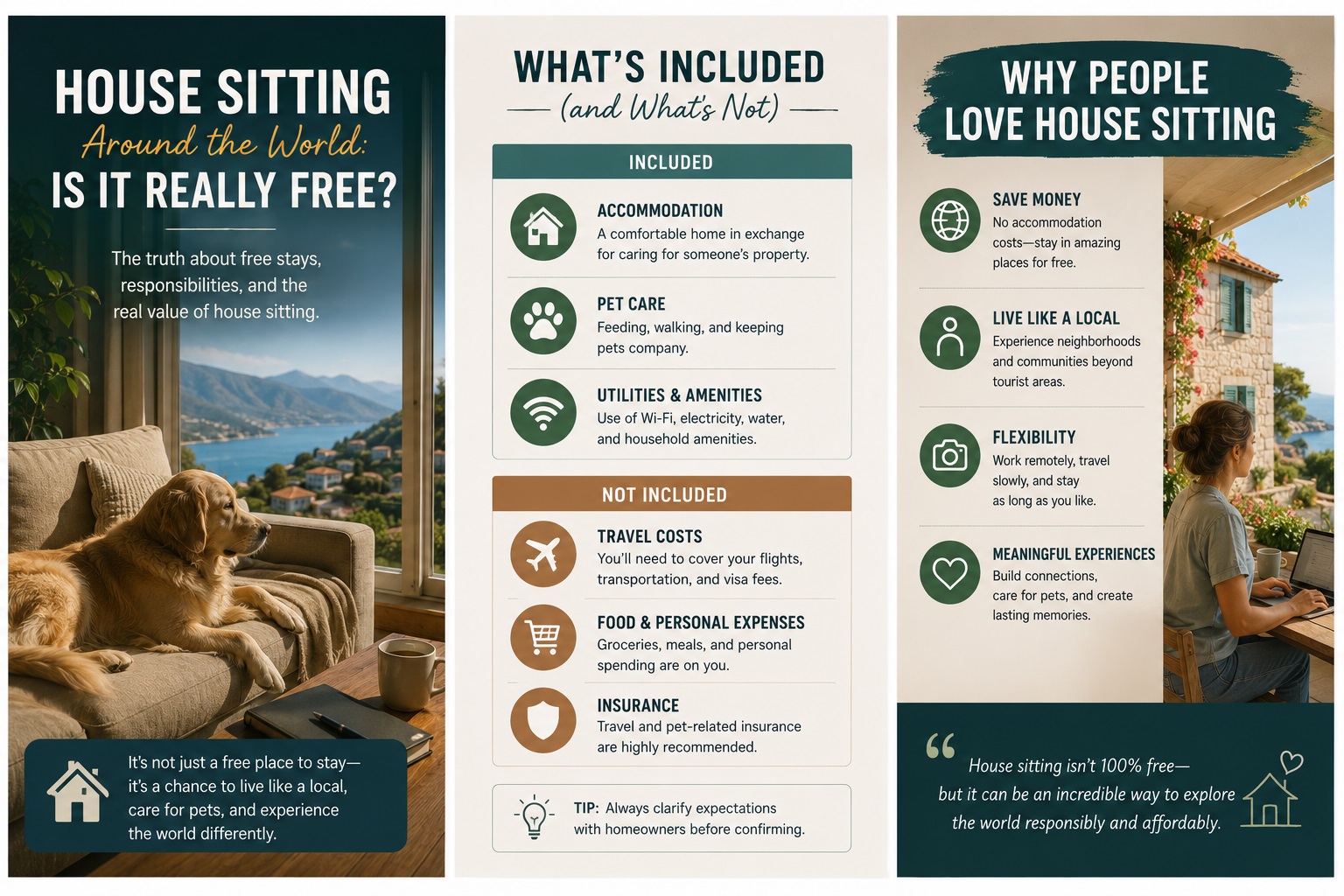
The basic arrangement is simple. A homeowner — the "host" — needs to leave their property for a period of time, anywhere from a few days to several months. They'd rather have someone responsible living there than leave it empty, particularly if they have pets that can't go to a kennel or plants that need watering or a property that benefits from occupied-looking activity. They list the assignment on a house sitting platform, describe what they need, and invite applications from registered sitters. The sitter stays in the home for free. In exchange they do whatever the host requires — usually pet care, sometimes light garden maintenance, occasionally other tasks. No money changes hands for accommodation. The sitter pays for their own food, transport, and any personal expenses. The host pays for utilities and any pet-related supplies already in the house. That's the model at its most straightforward. The variations come from the platform you use, the specific assignment, the relationship you develop with the host, and whether "free" accounts for all the actual costs involved.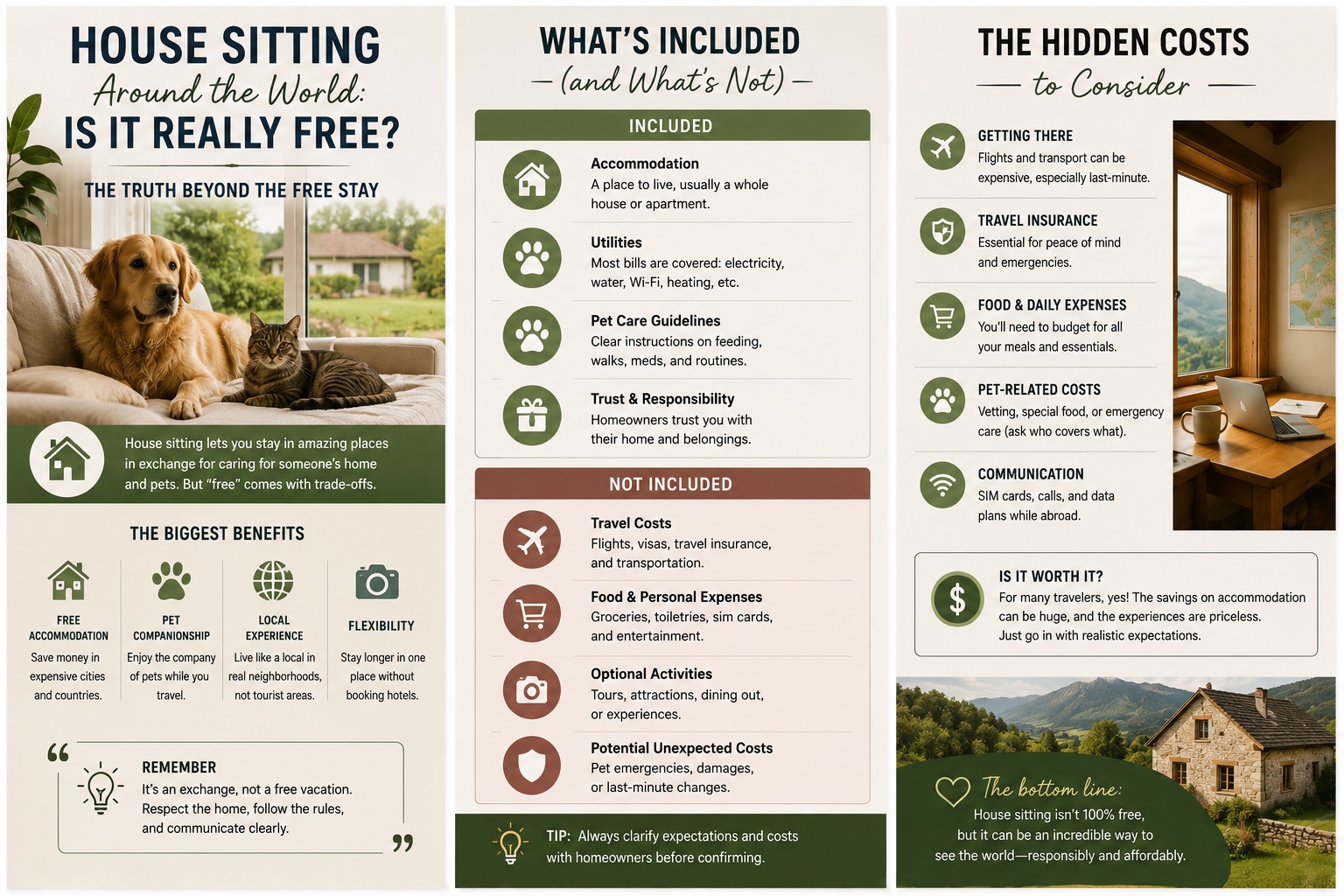
The Platforms and What They Cost
House sitting doesn't happen spontaneously. It happens through platforms that connect hosts and sitters, and those platforms charge membership fees that are the first thing most people overlook when calculating whether this is genuinely free. TrustedHousesitters is the largest and most established platform globally. It has the widest range of listings across the most countries and the most sophisticated review system. Annual membership for sitters currently costs around $129 for a standard plan. If you use it for one assignment that saves you $100 a week in accommodation, it's paid for itself. If you use it for multiple assignments in a year, it's an exceptional value. But the fee is real and needs to be factored in. Nomador is the main European alternative and has a strong selection of French, Spanish, and broader European listings. Annual fees are comparable to TrustedHousesitters. MindMyHouse is smaller and cheaper — around $20 per year — with fewer listings but reasonable coverage in English-speaking countries. HouseCarers is another established platform with global coverage, mid-range pricing, and a straightforward interface. Most serious house sitters end up with memberships on two platforms to maximize assignment options. The combined annual cost of two platforms runs $150–250 — real money, but money that gets recovered quickly once you're doing regular assignments. The first honest answer to "is it really free?" is: free at the point of use, with an upfront platform cost that becomes negligible over multiple sits.What the Arrangement Actually Requires
This is where the "free" part becomes more nuanced, because house sitting isn't passive. You're exchanging something for the accommodation — your time, your presence, and your reliability — and it's worth being clear about what that actually looks like. Pet care is the most common requirement and the one that shapes the trip most significantly. Looking after one or two dogs means walking them, feeding them, keeping them company, and being present enough that they're not anxious. This is not onerous if you like animals and find it enjoyable. It is a genuine constraint on your schedule — you can't be out from 8am to midnight every day exploring, because the dog needs walking, feeding, and company. Most experienced sitters describe it as something between a responsibility and a pleasure, depending on the animal. Cats are easier. They're more independent, need feeding and some attention, and are generally fine if you're out for most of the day. A two-cat sit in Rome is a different commitment from a three-dog sit in rural France. Property care varies by assignment. Some hosts want almost nothing beyond presence — being there, keeping things clean, maybe watering a few plants. Others have more involved requirements: pool maintenance, garden watering on a schedule, mail collection, occasional trades people access. Read the listing carefully and ask questions before accepting an assignment. The scope of what's expected should be clear before you commit. Flexibility. House sitting doesn't work if you need to be in a specific city on a specific date. Assignments are listed when hosts decide to travel, which doesn't always align with when you want to be somewhere. The travelers who use house sitting most successfully are those with flexible schedules — remote workers, retirees, people between jobs — who can move their plans to match available assignments rather than the other way around.What Free Accommodation Is Actually Worth
To understand the value of house sitting, it helps to know what accommodation in the relevant locations would otherwise cost. A comfortable Airbnb in Tuscany for three weeks runs $1,500–2,500 depending on location and season. A flat in Lisbon for a month: $1,200–2,000. A house in Cape Town for two weeks: $1,000–1,800. These are not luxury prices — these are mid-range accommodation costs in desirable locations. House sitting replaces these costs entirely. Not with a budget option, not with shared accommodation — with a private home that's typically nicer and more spacious than what you'd rent independently at the same price. Many house sits include access to a garden, a full kitchen, a comfortable living room, sometimes a pool or a car. The quality of the accommodation is often significantly above what a traveler at the same budget would otherwise afford. My friend's Tuscany farmhouse had a terrace overlooking olive groves, a kitchen stocked with the host's wine and olive oil which she was welcome to use, and two dogs who were genuinely good company. The equivalent rental in the same area would have cost her €1,800 for three weeks. She paid €0.Building a Profile That Gets Accepted
The competitive reality of house sitting is that good assignments in desirable locations receive many applications. A first-time sitter with no reviews competing for a cottage in Provence against a sitter with forty five-star reviews and a detailed profile is not competing on equal terms. The path through this is the same as any reputation-based system: start with the assignments that are easier to get, do them well, collect reviews, and use those reviews to access better assignments. First sits are typically in less competitive locations, at shorter durations, with easier pets, in the off-season. They're not the Tuscany farmhouse — they're a flat in a mid-sized city, a suburban house, somewhere that doesn't attract hundreds of applications. Do these well and you have a foundation. Your profile is the first thing hosts see and the thing that differentiates you from other applicants who have similar experience. Include a clear photograph of yourself. Write about who you are, your experience with animals, your lifestyle, and what makes you reliable. Be specific about your situation — "I'm a freelance writer working remotely, which means I'll be home most of the day and your pets won't be left alone" is more useful to a host than "I love animals and travel." References from previous hosts, neighbours, or employers who can speak to your reliability are worth including, particularly before you have sits under your belt. Your application message to each host matters more than most people realise. A short, generic message that could have been sent to any listing reads as exactly that. A message that references specific things in their listing — the name of their dog, something about the property or the destination, a question about their specific needs — reads as genuine interest. Hosts can tell the difference, and they respond to it.The Actual Costs of a House Sitting Trip
"Free accommodation" is real, but it's worth mapping out what a house sitting trip actually costs in total, because accommodation is not the only expense. Platform fees: $150–250 per year for two platforms, as above. Getting there: You pay your own transport. Flying to Tuscany, taking a train to a rural cottage in Scotland, driving to a property outside a city — these costs are your own. House sitting doesn't make travel free, it makes accommodation free. The calculation changes if you're doing multiple sits in the same country or region, where the travel between them is modest. Food: Entirely your own expense. Some hosts leave food in the fridge for your first day, or invite you to use pantry staples, but food costs are yours. In a house with a full kitchen, these costs are lower than in a hotel situation because you can shop and cook — one genuine financial advantage over accommodation without a kitchen. The hidden cost that most people don't mention: your time in a specific location has value. A house sit in a beautiful location that you didn't particularly want to visit is not a cost-free win if you're spending time there that you'd rather spend elsewhere. The more intentional you are about which sits you apply for — choosing locations you genuinely want to be in, for durations that make sense for your trip — the more the value equation works in your favor.The Things That Go Wrong
House sitting works well when hosts and sitters are honest, prepared, and compatible. It works less well when any of those elements are missing. The property doesn't match the listing. Photos taken with a wide-angle lens in good light can make a cramped cottage look spacious and well-maintained. The listing that described a "charming rural retreat" turns out to be a damp house at the end of a muddy track with no car and the nearest shop four miles away. This is avoidable — video calls with the host before accepting, recent reviews from other sitters, specific questions about the property — but it happens. The pets are more work than described. The dog that was described as "easy-going and well-trained" turns out to have separation anxiety and howls when left alone. The cats that "pretty much look after themselves" need medication twice a day. Most hosts are not deliberately misleading — they've normalised their pets' behaviour — but asking specific questions about the animal's routine and any quirks before accepting prevents surprises. Personal chemistry doesn't work. Most hosts and sitters don't overlap in person for more than a handover day or two, if at all. But some sits involve staying in a home where the host is present for part of the time, or in a property adjacent to theirs. If the personal dynamic isn't comfortable, a long sit becomes a long sit in an uncomfortable situation. A video call before accepting can reveal a lot about whether this is likely to be a problem. The emergency that wasn't planned for. A pet gets sick. A pipe leaks. A tree falls on the fence. The host is unreachable. How you handle these situations — and having a clear conversation with the host before they leave about what to do and who to call — determines whether an unexpected event is a manageable inconvenience or a genuinely bad experience.Who House Sitting Works Best For
The honest answer is that house sitting is not a good fit for everyone, and it's worth being clear about who it actually suits. It works well for remote workers with flexible schedules who can take assignments as they come up and who are home enough during the day that pets aren't left alone for long stretches. It works well for retirees who have time, flexibility, and often a genuine love of animals and domestic routine. Some of the most prolific house sitters are retired couples who have effectively replaced expensive retirement travel with a series of comfortable sits in places they want to be. It works well for people in between things — between jobs, between relationships, between phases — who have time and flexibility that a regular work schedule wouldn't allow. It works less well for people who need to be in specific places on specific dates, who don't like animals, who find it hard to be in someone else's home for extended periods, or who want the anonymity and detachment of a hotel room after a day of sightseeing.Is It Really Free?
The honest answer: almost. The accommodation is free. The platform fees are real but modest — around $150–250 per year split across two platforms — and they become negligible once you're doing regular sits that save you thousands in accommodation costs. The food and transport are your own expenses, same as any trip. The time commitment of pet care is real and shapes your schedule. What you get in return is private accommodation that's frequently nicer than anything you'd rent independently at the equivalent budget, in locations you choose, for durations that work for your trip — with the specific pleasure of living in someone's home rather than passing through it, having animals for company if you like that, and the particular texture of being briefly rooted somewhere rather than perpetually transiting. For the right kind of traveler, it's one of the better systems going. For the wrong kind, it's an obligation masquerading as a benefit. Figure out which one you are before you sign up.Considering house sitting for an upcoming trip or want to know which platform to start with? Leave a comment and I'll tell you what I'd do in your situation.


